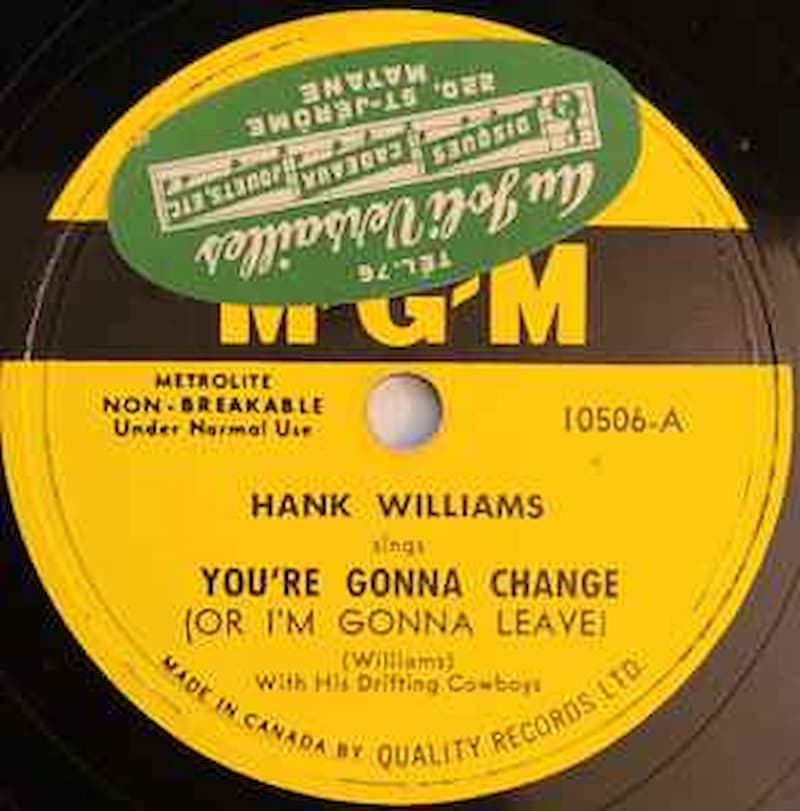
About The Song
“You’re Gonna Change (Or I’m Gonna Leave)” is a country and western song written by Hank Williams and recorded with His Drifting Cowboys for MGM Records. Williams cut the track at Castle Studio in Nashville, Tennessee, on March 2, 1949, with producer Fred Rose overseeing the session. It was published by Acuff-Rose on August 5, 1949 and released as single MGM K10506 in September 1949, with “Lost Highway” on the B-side. On Billboard’s Best Selling Retail Folk (country) chart, the record climbed to No. 4, making it one of Williams’s early Top 10 hits as his national profile was rapidly growing.
The release came in the middle of a particularly productive year. In 1949 Williams had already reached the country charts with “Lovesick Blues,” “Wedding Bells,” “Mind Your Own Business” and “My Bucket’s Got a Hole in It,” and he would follow with further hits into 1950. uDiscover Music notes that “You’re Gonna Change” entered the country listings around October 1, 1949, becoming one of six charting singles for Williams that year. It reinforced his reputation as a plain-spoken honky-tonk singer who could turn everyday domestic problems into commercially successful songs.
Session documentation lists a core group of Nashville players on the March 2 date. Williams was backed by Dale Potter on fiddle, Don Davis on steel guitar, Zeb Turner on lead guitar, Clyde Baum on mandolin, Jack Shook on rhythm guitar and probably Ernie Newton on bass. The recording was made at Castle Studio in the Tulane Hotel, where many of his late-1940s and early-1950s MGM masters were cut. Rose kept the arrangement concise and radio-oriented, with a running time just under three minutes and clear emphasis on Williams’s vocal and the interplay between fiddle and steel.
Lyrically, the song is an ultimatum addressed to a difficult partner. The narrator accuses his wife of lying, mistreating him and threatening to leave, and replies that “you’re gonna change, or I’m gonna leave.” Biographer Colin Escott has written that the piece was “clearly born of the dissent on Charles Street,” referring to the often stormy home life that Williams shared with his first wife, Audrey, in Nashville. The song belongs to the same group of domestic-friction titles as “I Just Don’t Like This Kind of Living” and “Why Don’t You Love Me,” but here the stance is more confrontational, centered on a clear warning rather than self-criticism.
Musically, “You’re Gonna Change” is typical of Williams’s up-tempo honky-tonk A-sides of the period. It is built around a straightforward country & western groove with a strong backbeat, leaving space for short instrumental fills between vocal lines. Commentators describe it as a danceable barroom number, designed for jukeboxes and live shows as much as for home listening. The combination of direct language, a memorable title line and a tight band performance made it an effective vehicle for Williams’s emerging style, blending elements of hillbilly, country blues and the harder edge that would influence later rockabilly recordings.
On the charts, the single’s No. 4 peak confirmed that Williams could follow “Lovesick Blues” with a continuing run of hits rather than a single breakthrough. The B-side, “Lost Highway,” also became well known, especially in hindsight, even though it charted lower at the time. Later writers have pointed out that the themes of “You’re Gonna Change” reappear in Williams’s posthumously released “You Better Keep It on Your Mind,” where the narrator again warns a partner not to take him lightly, suggesting a continuity of subject matter across his catalogue.
The song has remained in circulation through cover versions and reissues. It appears on major compilations such as 40 Greatest Hits and The Complete Hank Williams, ensuring its availability alongside his most famous titles. George Jones recorded it for his 1962 tribute album My Favorites of Hank Williams, Hank Williams Jr. included a version on his 1975 LP Hank Williams Jr. & Friends and re-cut it for later projects, Emmylou Harris recorded it for her 1980 album Roses in the Snow, and Tom Petty contributed a rendition to the 2001 tribute set Timeless: Hank Williams Tribute. These interpretations, along with the original MGM single, have helped establish “You’re Gonna Change (Or I’m Gonna Leave)” as one of the key honky-tonk statements in Hank Williams’s body of work.
Video
Lyric
You wore out a brand-new trunk
Packin’ and unpackin’ your junk
Your daddy’s mad, he’s done got peeved
You’re gonna change or I’m a-gonna leave
You’re gonna change your way of livin’, change the things you do
Stop doin’ all the things that you oughtn’t do
Your daddy’s mad, he’s done got peeved
You’re gonna change or I’m a-gonna leave
This ain’t right and that is wrong
You just keep naggin’ all the day long
It’s gotta stop, I don’t mean please
Now you’re gonna change or I’m a-gonna leave
The way to keep a woman happy and make her do what’s right
Is love her every mornin’, bawl her out at night
Your daddy’s mad, he’s done got peeved
Now you’re gonna change or I’m a-gonna leave
Every time you get mad
You pack your rags and go back to Dad
You tell him lies he don’t believe
Now you’re gonna change or I’m a-gonna leave
You’re gonna change your way of livin’, change the things you do
Stop doin’ all the things that you oughtn’t do
Your daddy’s mad, he’s done got peeved
You’re gonna change or I’m a-gonna leave