About The Song
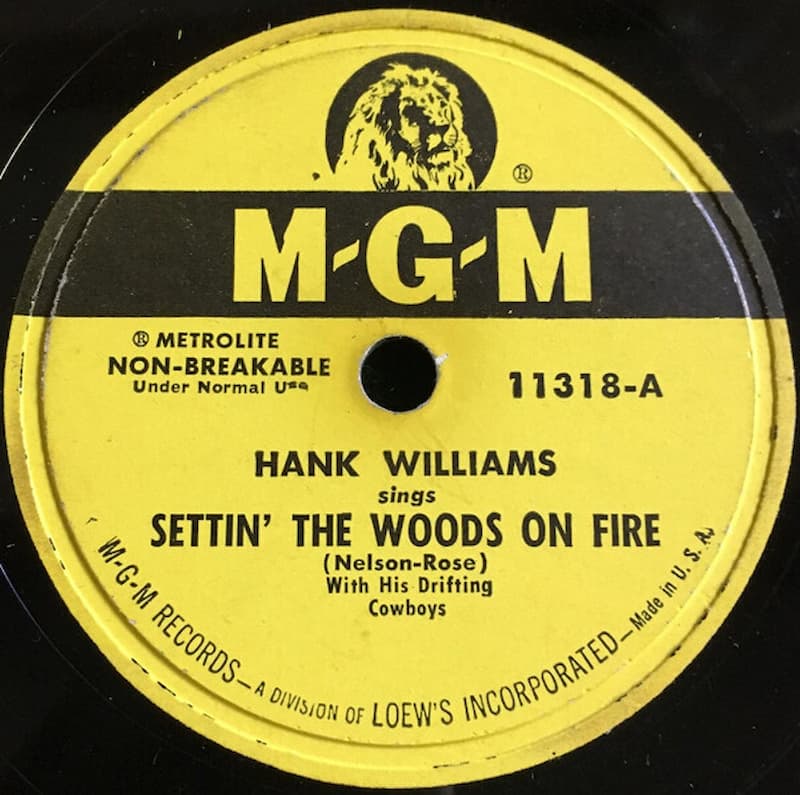
“Settin’ the Woods on Fire” is a 1952 single recorded by Hank Williams with His Drifting Cowboys for MGM Records. Although it closely matches Williams’s own style, the song was actually written by his producer and publisher Fred Rose together with songwriter Ed G. (Edward) Nelson. Williams cut the track at Castle Studio in Nashville on June 13, 1952, and it was released as MGM 11318 in September that year, with “You Win Again” on the B-side. On the U.S. country charts it reached No. 2 on Billboard’s Most Played by Jockeys chart and No. 2 on the National Best Sellers list, giving Williams another major hit in a run of early-1950s successes.
The single followed directly on the heels of “Jambalaya (On the Bayou),” which was recorded at the same June 13 session and was still at No. 1 on the country listings when “Settin’ the Woods on Fire” debuted. Rose and Nelson’s composition was published by Milene Music on July 29, 1952, and tailored very specifically to Williams’s honky-tonk image. Contemporary and later commentators often note that, despite the outside writing credits, it “sounds remarkably like a Hank Williams composition,” fitting seamlessly into his catalogue of up-tempo barroom songs while giving his publishing and production team a prominent role.
In the studio, Williams was backed by a small, polished Nashville band. The Castle Studio line-up included Jerry Rivers on fiddle, Don Helms on steel guitar and Harold Bradley on rhythm guitar, with many sources suggesting that Chet Atkins played lead guitar and Ernie Newton handled bass, under Fred Rose’s supervision in the control room. The session that day also produced “Jambalaya (On the Bayou)” and “I’ll Never Get Out of This World Alive,” making it one of the most productive dates in Williams’s recording career. The finished master of “Settin’ the Woods on Fire” runs around two minutes and thirty-eight seconds, typical of a jukebox-oriented country single of the period.
Lyrically, the song describes a wild night out with a sweetheart, built around the promise that “tonight we’re settin’ the woods on fire.” The narrator urges his partner to “comb your hair and paint and powder,” promises that he will “act prouder,” and looks forward to taking in all the honky-tonks and showing the folks a “brand-new dance that never has been done.” Later lines about doing “all the law’s allowin’” and being back “right back plowin’” the next day sketch a picture of rural working people cutting loose for one evening and then returning to ordinary responsibilities. The tone is playful and celebratory, with no real narrative beyond the anticipation of fun.
Musically, “Settin’ the Woods on Fire” blends country & western, honky-tonk and blues influences in a way that some historians describe as pointing directly toward rockabilly. The arrangement is driven by a strong backbeat, bright electric guitar lines, Rivers’s fiddle and Helms’s distinctive steel fills, all supporting Williams’s confident, slightly swaggering vocal. Colin Escott, in his biography of Williams, argues that the record “pointed unerringly toward rockabilly,” noting how its rhythmic feel and emphasis on youthful excitement anticipate the rock-and-roll sound that would emerge later in the decade.
On the charts, the single enjoyed a 12-week run on the country listings, peaking at No. 2 while its flip side “You Win Again” also attracted its own airplay and reached No. 10. This double-sided success underlined Williams’s commercial strength in 1952, when multiple singles could occupy high positions on different Billboard country surveys at the same time. Retrospective chart histories often list “Settin’ the Woods on Fire” among the standout country records of that year, alongside “Jambalaya” and other Williams hits.
The song has had a long afterlife through cover versions and media use. In 1952 Frankie Laine and Jo Stafford released a duet version with a stronger pop orientation, and later recordings have come from Johnny Burnette, George Jones, Porter Wagoner, Mason Proffit, Chris LeDoux and the Tractors, among others. The track has also appeared in film and television—for example, characters sing it in an episode of The Batman—helping keep it in the public ear. Today, “Settin’ the Woods on Fire” is regularly included on Hank Williams compilations such as 40 Greatest Hits and is widely regarded as one of his definitive up-tempo sides, capturing the more exuberant, good-time side of his music that balanced his darker, more tragic ballads.
Lyric
Comb your hair and paint and powder
You act proud and I’ll act prouder
You sing loud and I’ll sing louder
Tonight we’re settin’ the woods on fire
You’re my gal and I’m your feller
Dress up in your frock and yeller
I’ll look swell but you’ll look sweller
Settin’ the woods on fire
We’ll take in all the honky-tonks tonight we’re having fun
We’ll show the folks a brand new dance that never has been done
I don’t care who thinks we’re silly
You’ll be daffy I’ll be dilly
We’ll order up two bowls of chili
Settin’ the woods on fire
I’ll gas up my hot-rod stoker
We’ll get hotter than a poker
You’ll be broke but I’ll be broker
Tonight we’re settin’ the woods on fire
We’ll sit close to one another
Up one street and down the other
Tonight we’ll have ball, oh brother
Settin’ the woods on fire
We’ll put aside a little time to fix a flat or two
My tires and tubes are doin’ fine but the air is showin’ through
You clap hands and I’ll start bowin’
We’ll do all the law’s allowin’
Tomorrow I’ll be right back plowin’
Settin’ the woods on fire