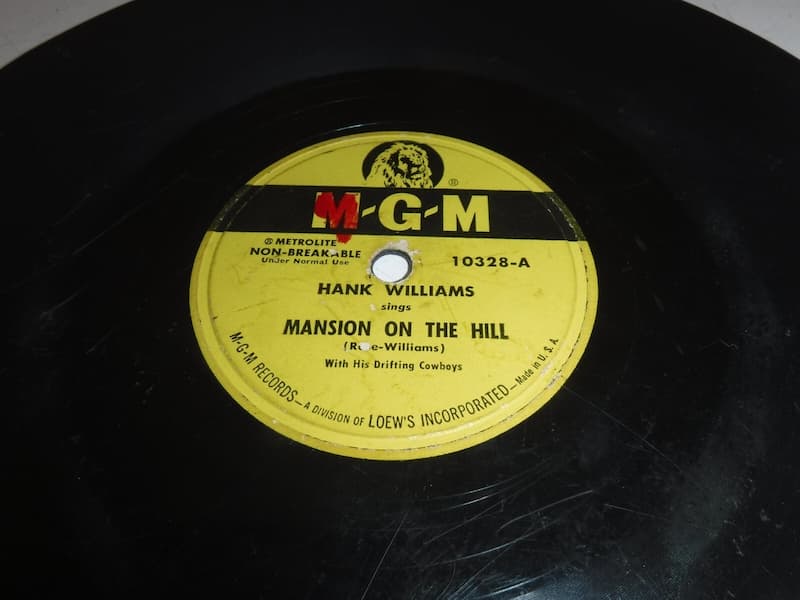
About The Song
“A Mansion on the Hill” is a country song written by Hank Williams and producer Fred Rose and recorded by Williams with His Drifting Cowboys for MGM Records. Session and label data show that he cut the master at Castle Studio in Nashville on November 7, 1947, with Rose supervising. The song was published by Acuff-Rose Publications on November 30, 1948 and released as a single in December 1948, backed with “I Can’t Get You Off of My Mind.” It is usually classified as hillbilly and country blues and runs about two and a half minutes.
The origins of the song are not fully documented, but biographical sources agree that it played an important role in Williams’s early relationship with Acuff-Rose. Accounts repeated in later histories say that Fred Rose asked Williams to come up with a new song during an early meeting, and the result—later titled “A Mansion on the Hill”—helped convince Rose to sign him to a publishing contract. Musically, the melody draws on Bob Wills’s 1938 recording “I Wonder If You Feel the Way I Do,” which Williams and Rose adapted into a slower, more introspective country ballad with new lyrics.
The November 1947 recording session brought together some of Nashville’s key studio players of the era. Documentation lists Jerry Byrd on steel guitar, Chubby Wise on fiddle, Zeke Turner on lead guitar, probably Louis Innis on bass and either Owen Bradley or Fred Rose on piano. The arrangement is sparse but polished: acoustic rhythm and bass provide a foundation, while steel and fiddle offer short fills around Williams’s vocal lines. Producer Fred Rose kept the performance compact and radio-friendly, a pattern that would characterize many of Williams’s later MGM singles.
Lyrically, “A Mansion on the Hill” contrasts wealth and emotional poverty. The narrator stands outside a grand house, imagining the happiness it seems to represent, but insists that “love don’t live there anymore.” The verses describe lights shining in the window and music drifting out, yet he remains alone, separated from the person he once loved. The text uses simple, direct language to convey feelings of exclusion and regret, and the repeated image of the mansion functions as a symbol for a lost relationship rather than a literal description of property or status.
On Billboard’s country charts, the single gave Williams an early national hit. Chart summaries and discographies show that “A Mansion on the Hill” entered the Most Played Jukebox Folk Records (country) listing in March 1949 and peaked at No. 12. It appeared on the same chart at the same time as his breakthrough hit “Lovesick Blues,” which reached No. 1 and remained on the survey for many weeks. Although it did not match that level of success, “A Mansion on the Hill” contributed to the run of Top 20 records that raised Williams’s profile in 1948–49 and helped lead to his Grand Ole Opry debut.
The song later appeared on Williams’s first MGM LP, Hank Williams Sings, released in 1951, which compiled several of his early single sides. It has since been included on many compilations, including major retrospectives such as 40 Greatest Hits and multi-disc box sets. These reissues have kept the track in circulation as a representative example of his late-1940s ballad style and of the material he developed in collaboration with Fred Rose during his first years with MGM.
“A Mansion on the Hill” has also attracted a long list of cover versions, underscoring its status as a country standard. Kitty Wells recorded it in 1957, Hank Snow included it on a 1961 LP, and George Jones cut a version for his 1962 album of Hank Williams songs. Later renditions have come from Roy Acuff, Willie Nelson, Roy Orbison, Michael Martin Murphey (with John Denver), Ray Price, Charley Pride, Moe Bandy, Tompall Glaser and the Glaser Brothers, Waylon Jennings and others. Bruce Springsteen’s 1982 song “Mansion on the Hill” from his album Nebraska was directly inspired by the Williams title, demonstrating the song’s influence beyond traditional country music.
Within Hank Williams’s catalogue, the track is often cited as an early showcase for his ability to combine simple melodies with evocative imagery. Its moderate chart success, important role in securing his publishing deal and long history of reinterpretation have made “A Mansion on the Hill” one of the key ballads from his pre–”Lovesick Blues” period, pointing toward the mixture of heartbreak themes and plain-spoken language that would define much of his later work.
Video
Lyric
Tonight down here in the valley
I’m lonesome and oh how I feel
As I sit here alone in my cabin
I can see your mansion on the hill
Do you recall when we parted
The story to me you revealed
You said you could live without loving
In your loveless mansion on the hill
I’ve waited all through the years love
To give you a heart true and real
‘Cause I know you’re living in sorrow
In your loveless mansion on the hill
The light shine bright from yer window
The trees stand so silent and still
I know you’re alone with your pride dear
In your loveless mansion on the hill