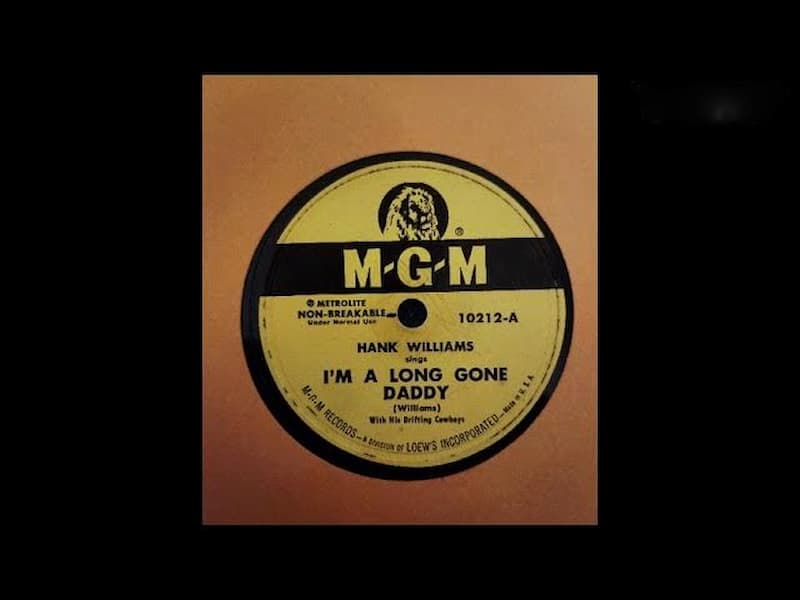
About The Song
“I’m a Long Gone Daddy” is a country song written and recorded by Hank Williams with His Drifting Cowboys for MGM Records. He cut the track at Castle Studio in Nashville on November 6, 1947, with producer Fred Rose in charge. Released as a single in June 1948 on MGM 10212, it was paired with “The Blues Come Around” on the B-side and later published by Acuff-Rose on August 13, 1948. Classified as hillbilly, honky-tonk and country blues, the record became Williams’s second Top 10 country hit and an important step in his early career with MGM.
The session that produced “I’m a Long Gone Daddy” came at a strategic moment. With the American Federation of Musicians threatening a recording ban at the end of 1947, Rose wanted to stockpile usable masters that MGM could release if a strike stopped new sessions. For this date he assembled a band from two Grand Ole Opry outfits: Zeke Turner on lead guitar, Jerry Byrd on steel guitar and Louis Ennis on rhythm guitar from Red Foley’s band, plus Chubby Wise on fiddle from Bill Monroe’s group. Rose himself may have played piano. The same November 6 session also yielded “I Can’t Get You Off of My Mind,” a new version of “Honky Tonkin’” and Rose’s song “Rootie Tootie,” giving MGM several sides ready for the coming year.
Musically, “I’m a Long Gone Daddy” laid out what would become the template for a Hank Williams A-side. Commentators describe it as an up-tempo honky-tonk number in the Ernest Tubb tradition, but with a stronger blues edge in the vocal phrasing and guitar lines. The arrangement is straightforward and compact: a driving rhythm from acoustic and electric guitars and bass, steady fiddle support and prominent steel guitar fills between vocal phrases. The track runs just over two minutes, tailored for jukebox and radio play, and showcases the tight, professional sound Rose was building around Williams at Castle Studio.
Lyrically, the song presents a narrator who is fed up with his partner’s behavior and announces that he is leaving for good. He complains about being mistreated and taken for granted, then declares that he is a “long gone daddy” who will not be around when she changes her mind. The text is built from short, conversational lines and a simple refrain, with no elaborate backstory beyond the decision to walk away. This mixture of defiant tone, everyday language and a memorable hook would appear again in later Williams songs dealing with fractured relationships and domestic conflict.
On the charts, “I’m a Long Gone Daddy” performed well for a relatively early MGM single. Billboard’s Most Played Juke Box Folk Records chart (the main country jukebox listing of the time) shows the record reaching No. 6 in 1948, giving Williams his second Top 10 country hit after the success of his remake of “Honky Tonkin’.” Educational and biographical summaries of his career note that, alongside “Honky Tonkin’,” the single helped establish Williams as more than a regional act, demonstrating that his blend of honky-tonk and blues could compete nationally in the late-1940s country market.
The song has also had a longer life through its B-side and later releases. “The Blues Come Around,” written and recorded at the same period, is often mentioned alongside “I’m a Long Gone Daddy” as part of a cluster of early honky-tonk recordings that point toward the sound of “Move It On Over” and the big MGM hits that followed. The A-side itself reappeared on later compilations, including the 1952 10-inch LP Moanin’ the Blues and subsequent anthologies that group Williams’s late-1940s sides for collectors and new listeners.
Over the decades, “I’m a Long Gone Daddy” has attracted numerous cover versions and cultural references. Bobby Helms recorded the song in the 1950s, Ernest Tubb cut a version in 1959, and Hank Williams Jr. recorded it for his 1964 album Sings the Songs of Hank Williams, later revisiting it on the 1990s project Three Hanks: Men with Broken Hearts using his father’s original vocal alongside his own and Hank Williams III. George Jones and the British band The The also recorded notable covers. Outside country music, Bruce Springsteen quoted the title line in his 1984 song “Born in the U.S.A.” with the phrase “I’m a long gone daddy in the U.S.A.,” a nod that underlines the song’s lasting place in American popular culture.
Video
Lyric
Start off here with a little song a guy wrote here
A few years ago
This man got tired of his wife beating him on the head with a frying pan
So he wrote her a song, title of it is
“I’m a long gone daddy”
Well, all you wanna do is sit around and pout
And now I got enough and gal I’m getting out, I’m leaving now
I’m leaving now
Well, I’m a long gone daddy, I don’t need you anyhow
I been in the doghouse so doggone long
When I get a kiss I think there’s something’s wrong, so I’m leaving now
I’m leaving now
Well, I’m a long gone daddy, I don’t need you anyhow
I remember back when you were nice and sweet
But things have changed, you’d rather fight than eat, so I’m leaving now
I’m leaving now
Well, I’m a long gone daddy, I don’t need you anyhow
I’ll go find a gal that wants to treat me right
You go get yourself a man that wants to fight, cause I’m leaving now
I’m leaving now
Well, I’m a long gone daddy, I don’t need you anyhow
Well, you start your jaws a-wagging and they never stop
You never shut your mouth until I blow my top, so I’m leaving now
I’m leaving now
Well, I’m a long gone daddy, I don’t need you anyhow
Well, I’m gonna do some riding on the midnight train
I’m taking everything except my ball and chain, ’cause I’m leaving now
I’m leaving now
Well, I’m a long gone daddy, I don’t need you anyhow
Alright, there you got it, I’m a long gone papa
Right now here’s our friend again with a little word for ya
So listen, we’ll be back in just a minute