About The Song
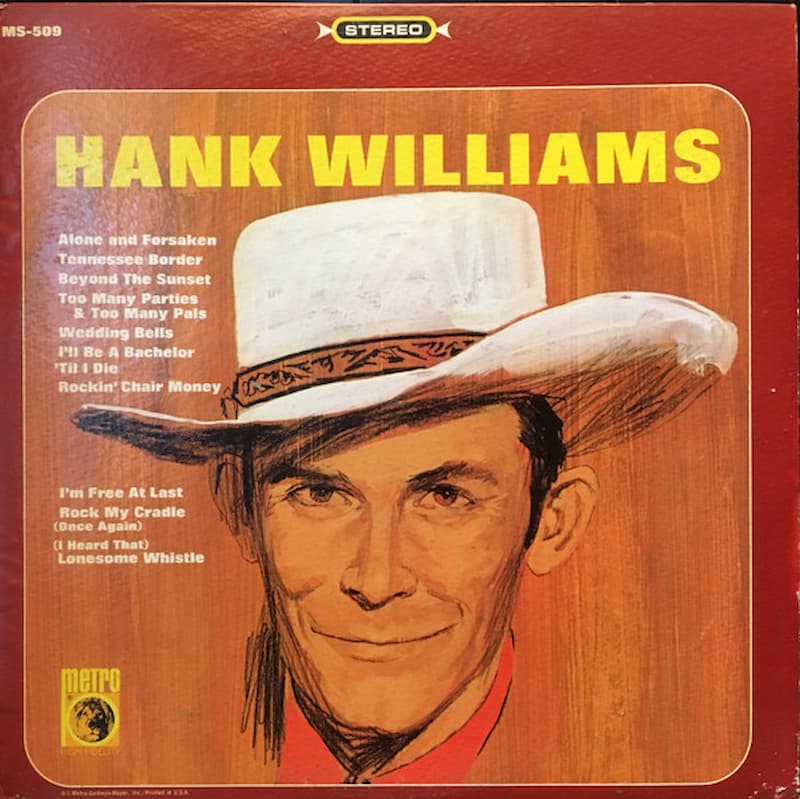
“(I Heard That) Lonesome Whistle” is a country song written by Hank Williams and Louisiana singer–songwriter Jimmie Davis. Credited to Hank Williams with His Drifting Cowboys, it was recorded at Castle Studio in Nashville on July 25, 1951, with Fred Rose producing. Issued by MGM Records later in 1951 as a single with “Crazy Heart” on the B-side, it was published by Jimmie Davis Music Corp. at the end of 1951 and is generally classified as a country and western and honky-tonk ballad. On Billboard’s country charts it reached the Top 10, peaking around No. 8–9 on the jukebox-oriented listings.
The song grew out of Williams’s friendship with Jimmie Davis, who had enjoyed major hits in the 1930s and 1940s with titles such as “You Are My Sunshine.” Sources note that Williams mentioned going fishing with Davis on one of his Mother’s Best Flour radio shows in early 1951, and biographer Colin Escott suggests the two may have completed the song around that time. The lyric combines two of country music’s most familiar themes—trains and prison—into a compact narrative, reflecting both writers’ backgrounds in southern storytelling and hillbilly music.
In the studio, Williams was supported by a core group of his Drifting Cowboys band. Documentation lists Don Helms on steel guitar, Jerry Rivers on fiddle, Sammy Pruett on electric lead guitar, Howard Watts (also known as Cedric Rainwater) on bass and probably Jack Shook on rhythm guitar, with Rose supervising from the control room. The performance runs roughly two and a half minutes. Rose’s production keeps the arrangement sparse, centering Williams’s vocal and Helms’s high, mournful steel lines, a sound that became a hallmark of Williams’s early-1950s records.
Lyrically, “(I Heard That) Lonesome Whistle” tells the story of a man who has been sentenced to prison after a life of drifting and bad choices. From his cell he hears a distant train whistle and realizes how far he has fallen from the freedom he once had. The song’s most distinctive device is Williams’s vocal imitation of the train whistle on the word “lonesome,” sliding upward in pitch to echo a steam locomotive. Commentators have noted that this combination of train imagery and incarceration likely influenced later songs such as Johnny Cash’s “Folsom Prison Blues,” which shares the idea of a prisoner haunted by the sound of a passing train.
Musically, the track is a slow to mid-tempo country blues in waltz time, built on a simple chord progression and straightforward rhythm. Acoustic guitar and bass provide a steady foundation, while fiddle and steel supply brief fills between vocal phrases. The overall sound is stark and reflective compared with some of Williams’s more up-tempo honky-tonk sides from the same period. Writers have singled out the recording for its uneasy mood and the way the vocal phrasing conveys both regret and resignation, despite the limited length typical of a 1950s country single.
On the charts, “(I Heard That) Lonesome Whistle” performed respectably. It entered the Billboard country rankings in late 1951 and reached the Top 10 on the Most Played Juke Box Folk (country) chart, while its flip side “Crazy Heart” climbed slightly higher. Even though it was not one of Williams’s biggest hits, the single continued the strong run of releases that also included “Cold, Cold Heart,” “Hey, Good Lookin’” and “Baby, We’re Really in Love,” and it reinforced his reputation for mixing blues-flavored material with more commercial honky-tonk songs.
Over the years, “(I Heard That) Lonesome Whistle” has remained a notable entry in Hank Williams’s catalogue. It has been reissued on major compilations such as 40 Greatest Hits, The Complete Hank Williams and themed collections focusing on his train or prison songs. Critics and historians often point to it as an example of his ability to compress a full story into a short lyric and to use small vocal gestures—such as the whistle-like glide on the title phrase—to create strong imagery. The track’s influence on later country and country-influenced writers has kept it in circulation as one of the key, if slightly less famous, ballads from Williams’s 1951 output.
Video
Lyric
I was riding number nine
Heading south from caroline
I heard that lonesome whistle blow
Got in trouble had to roam
Left my gal and left my home
I heard that lone some whistle blow
Just a kid actin’ smart
I went and broke my darlin’s heart
I guess I was too young to know
They took me off the georgia main
Locked me to a ball and chain
I heard that lonesome whistle blow
All alone I bear the shame
I’m a number not a name
I heard that lonesome whistle blow
All I do is sit and cry
When the ev’nin’ train goes by
I heard that lonesome whistle blow.
I’ll be locked here in this cell
Til my body’s just a shell
And my hair turns whiter than snow
I’ll never see that gal of mine
Lord, I’m in georgia doin’ time
I heard that lonesome whistle blow.