About The Song
“Half as Much” is a country and pop standard written by Curley Williams (no relation to Hank Williams) and recorded by Hank Williams with His Drifting Cowboys in 1951. Hank’s studio version was cut at Castle Studio in Nashville on August 10, 1951, with Fred Rose producing, and released by MGM Records in March 1952 as single K11260. It was issued with “I Can’t Help It (If I’m Still in Love with You)” on the flip side. Hank’s recording is usually classified as hillbilly, honky-tonk and country & western, running just under three minutes.
Although Hank Williams’s version is now widely remembered, the song was not originally his. Curley Williams (born Dock Williams), a bandleader and songwriter from Georgia, wrote “Half as Much” in the late 1940s. He and his group, the Georgia Peach Pickers, first recorded it in Nashville for Columbia Records in 1950. Publishing went through Acuff-Rose, which created a natural path for Fred Rose to pitch the song to Hank. As with other outside compositions such as “Wedding Bells,” Hank recognized that the lyric and melody suited his vocal style and added it to his MGM repertoire.
The August 1951 session that produced “Half as Much” drew on Hank’s core studio band. Don Helms played steel guitar, Jerry Rivers handled fiddle, Sammy Pruett played lead guitar, Howard Watts (often billed as Cedric Rainwater) was on bass, and Jack Shook likely contributed rhythm guitar, with Fred Rose supervising from the control room. The arrangement is clean and mid-tempo, with prominent steel and fiddle fills answering Hank’s vocal lines. Compared with some of his rawer honky-tonk sides, “Half as Much” leans slightly toward a smoother, more polished sound that was compatible with both jukeboxes and broader radio play.
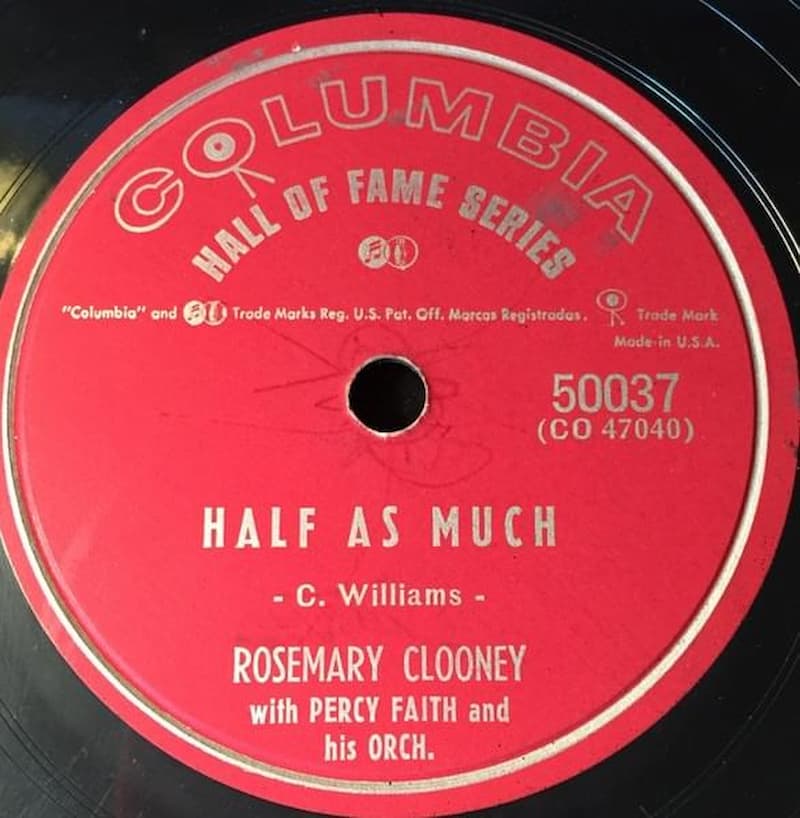
On the U.S. country charts, Hank Williams’s “Half as Much” was a solid success. Released in early 1952, it climbed to No. 2 on Billboard’s country best-seller and jukebox listings, extending the run of high-charting singles that included “Cold, Cold Heart,” “Hey, Good Lookin’” and “Jambalaya (On the Bayou).” However, the song’s biggest chart impact at the time actually came from a pop cover: Rosemary Clooney’s version, recorded for Columbia and arranged in an easy-listening style with strings and chorus, reached the Top 10 on the Billboard pop chart and helped establish the song as a true cross-over standard.
Lyrically, “Half as Much” presents a narrator who loves someone far more than that person loves them in return. The singer reflects that if the other person cared “half as much” as he does, they would not treat him so poorly or make him cry. The text is concise, built around the contrast between unbalanced affection and what a more equal relationship might look like. Its language is simple and direct, typical of mid-century country writing, and is easily adaptable to both male and female singers, which helped the song travel across genres.
Musically, Hank’s recording embodies his early-1950s mix of honky-tonk and smoother country balladry. The tune has a memorable, gently lilting melody with a clear verse–chorus structure. Helms’s steel guitar provides a singing, almost vocal counter-line, while Rivers’s fiddle supports the harmonic movement and adds short fills between phrases. The rhythm section keeps a steady, unobtrusive pulse, allowing Hank’s phrasing—slight delays at the ends of lines, small bends on key words—to carry the emotional emphasis. The result is a track that can be read either as a barroom lament or as a relatively polished radio ballad.
Over time, “Half as Much” has become one of the more widely covered songs associated with Hank Williams’s era. In addition to Rosemary Clooney’s pop hit, versions have been recorded by Patsy Cline, Ray Charles (on his influential country-themed albums), Jim Reeves, Marty Robbins and many others, sometimes leaning toward pop, sometimes toward pure country. Hank’s original MGM recording has been reissued on major compilations such as 40 Greatest Hits, The Complete Hank Williams and later box sets, keeping it in circulation for new listeners. Although it is not always ranked alongside “Your Cheatin’ Heart” or “Lovesick Blues” in discussions of his very biggest songs, “Half as Much” remains an important example of how Williams, Fred Rose and Acuff-Rose Publishing brought outside material into his catalogue and helped turn it into a staple of both the country and pop standards repertoire.
Video
Lyric
If you love me half as much as I love you
You wouldn’t worry me half as much as you do
You’re nice to me when there’s no one else around
You only build me up to let me down
If you missed me half as much as I miss you
You wouldn’t stay away half as much as you do
I know that I would never be this blue
If you only loved me half as much as I love you
If you love me half as much as I love you
You wouldn’t worry me half as much as you do
You’re nice to me when there’s no one else around
You only build me up to let me down
If you missed me half as much as I miss you
You wouldn’t stay away half as much as you do
I know that I would never be this blue
If you only loved me half as much as I love you