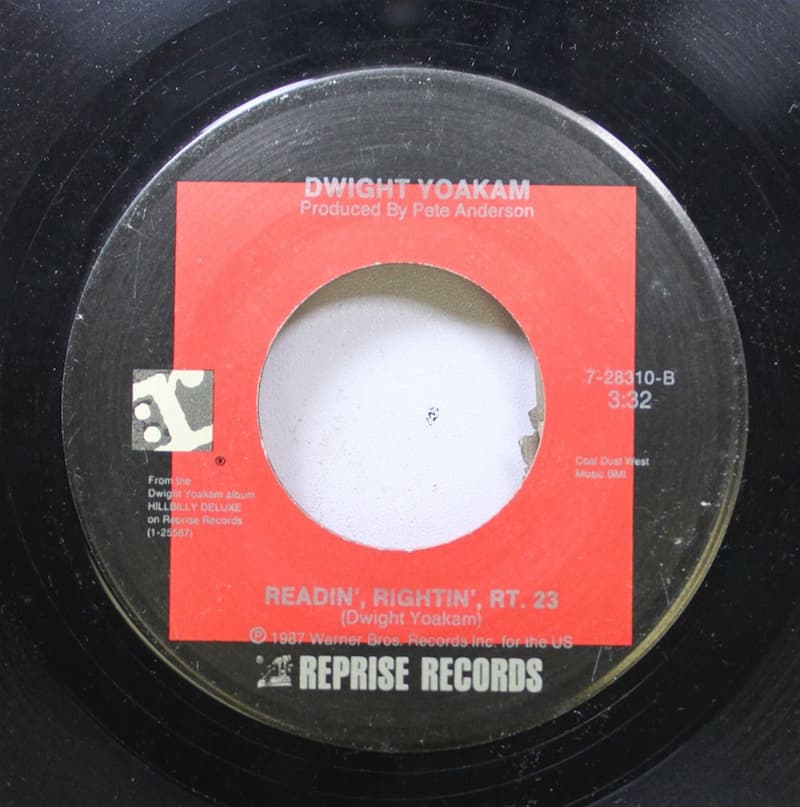
About The Song
“Readin’, Rightin’, Rt. 23” is a song written and recorded by American country artist Dwight Yoakam. It appears on his second studio album, Hillbilly Deluxe, released by Reprise Records on July 7, 1987. The album was produced by Pete Anderson and recorded at Capitol Studios in Hollywood. It became Yoakam’s second consecutive No. 1 on the Billboard Top Country Albums chart and helped consolidate his reputation as a leading figure in the 1980s neo-traditional country movement.
The track is also known as the B-side to the single “Little Ways,” which was issued in June 1987 as the second single from Hillbilly Deluxe. “Little Ways” reached No. 8 on the Billboard Hot Country Songs chart in the United States and climbed to No. 1 on the Canadian RPM Country Tracks chart. While “Readin’, Rightin’, Rt. 23” was not promoted as an A-side single in its own right, its presence on a successful 45 and on a hit album ensured that it was widely heard by country audiences in the late 1980s.
“Readin’, Rightin’, Rt. 23” is frequently described as one of Yoakam’s most autobiographical early songs. The title references U.S. Route 23, a highway that runs through eastern Kentucky and has long been associated with migration from the Appalachian coalfields to industrial cities in Ohio and the Midwest. Yoakam has family roots in this region, and biographical accounts note that he drew on memories of towns along Route 23 near his grandparents’ homes when writing the song. This connection places the track in a tradition of “hillbilly highway” songs about rural southerners leaving home in search of factory work.
Lyrically, the song focuses on the experience of a younger generation whose schooling prepares them to leave rather than stay. The chorus line about learning “readin’, writin’, Route 23” links basic education with the road that will carry them away to jobs in distant cities’ factories. Verses describe parents who spent their lives in the coal mines, contrasted with children who are increasingly drawn to opportunities elsewhere, often without realizing that the move will expose them to hardship and disillusionment. The language is plain and narrative, echoing Appalachian storytelling while addressing broader social change.
Musically, “Readin’, Rightin’, Rt. 23” sits comfortably within the Bakersfield-influenced honky-tonk sound that characterizes Hillbilly Deluxe. The arrangement uses electric guitar, pedal steel, fiddle and a steady rhythm section, with Anderson’s production leaving space for Yoakam’s vocal phrasing to carry the story. Critics have noted how the performance manages to sound wistful and driving at the same time, mirroring the tension between pride in one’s roots and the pull of leaving home. The track complements other songs on the album that explore working-class lives and rural identity.
The song later reappeared in stripped-down form on Yoakam’s acoustic album dwightyoakamacoustic.net, released in 2000. On that project it is presented with only voice and guitar, running a little over four minutes, which emphasizes the lyric and underlines its narrative strength. The continued inclusion of “Readin’, Rightin’, Rt. 23” in live sets and retrospective projects indicates that Yoakam regards it as a core statement about his background and the culture that shaped his writing.
Although “Readin’, Rightin’, Rt. 23” did not chart as a single, it is often singled out in critical discussions of Yoakam’s early work as a key example of his ability to combine traditional country forms with specific regional detail. Together with more widely known tracks from Hillbilly Deluxe, the song helped define him as an artist who could honor classic honky-tonk sounds while documenting the realities of Appalachian migration and working-class life in the late twentieth century.
Video
Lyric
They learned readin’, writin’, Route 23
To the jobs that lay waiting in those cities’ factories
They learned readin’, writin’, roads to the north
To the luxury and comfort a coal miner can’t afford
They thought readin’, writin’, Route 23
Would take them to the good life that they had never seen
They didn’t know that old highway
Could lead them to a world of misery
Have you ever been down Kentucky-way
Say south of Prestonburg
Have you ever been up in a holler
Have you ever heard
A mountain man cough his life away
From diggin’ that black coal
In those dark mines, those dark mines
If you had you might just understand
The reason that they left is all behind
They learned readin’, wrightin’, Route 23
To the jobs that lay waitin’ in those cities’ factories
They learned readin’, writin’, roads to the north
To the luxury and comfort a coal miner can’t afford
They thought readin’, writin’, Route 23
Would take them to the good life that they had never seen
They didn’t know that old highway
Could lead them to a world of misery
Have you ever seen ’em
Put the kids in the car after work on Friday night
Pull up in a holler about 2 a.m.
And see a light still shinin’ bright
Those mountain folks sat up that late
Just to hold those little grandkids
In their arms, in their arms
And I’m proud to say that I’ve been blessed
And touched by their sweet hillbilly charm
They learned readin’, writin’, Route 23
To the jobs that lay waiting in those cities’ factories
They learned readin’, writin’, roads to the north
To the luxury and comfort a coal miner can’t afford
They thought readin’, writin’, Route 23
Would take them to the good life that they had never seen
They didn’t know that old highway
Could lead them to a world of misery
Yeah, it turns out that that old highway,
Leads you to a world of misery
They found out that that old highway
Leads you to a world of misery…