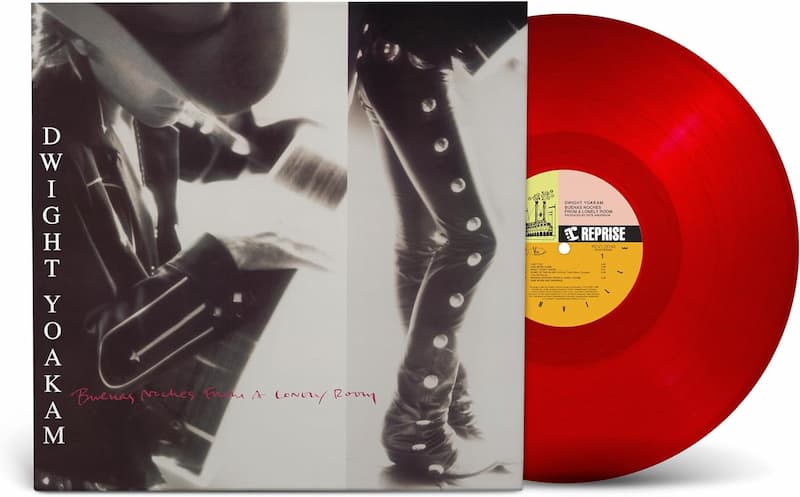
About The Song
“Buenas Noches from a Lonely Room (She Wore Red Dresses)” is the title track from Dwight Yoakam’s third studio album, Buenas Noches from a Lonely Room. The album was released on August 2, 1988, by Reprise Records and recorded at Capitol Studios in Hollywood, California. Produced by Yoakam’s longtime collaborator Pete Anderson, the record continued his blend of traditional honky-tonk and Bakersfield-influenced country at a time when more pop-oriented country was dominant on mainstream radio.
The album Buenas Noches from a Lonely Room is notable for containing Yoakam’s first two No. 1 singles on the Billboard Hot Country Songs chart: “Streets of Bakersfield” (a duet with Buck Owens) and “I Sang Dixie”, along with the Top 5 hit “I Got You”. Against this backdrop of commercial success, the title song was released as a later single and charted more modestly, peaking around the mid-40s on the U.S. country chart and entering the Canadian country listings in the lower Top 60. Even so, it is often treated by critics and biographers as one of the key artistic statements of the album, tying together its darker narrative threads.
Written by Dwight Yoakam, “Buenas Noches from a Lonely Room (She Wore Red Dresses)” functions as a modern murder ballad. The lyrics follow a narrator who recalls a woman “who wore red dresses” and “told such sweet lies”, had his child, and then abandoned him. As the song develops, the character moves from heartbreak and jealousy to violent revenge, ultimately tracking down the woman and her new lover and killing her. Within the loose song cycle of the album, this track is often cited as the culmination of a storyline that runs from romantic disillusionment to desperation and, finally, to a grim act of violence.
Musically, the track combines traditional country elements with Yoakam’s characteristic rhythmic and production choices. The arrangement features a steady, almost clock-like percussion pulse, twangy electric guitars, and a spare, echo-laden vocal sound that emphasizes the isolation and obsession in the lyric. The performance reflects Yoakam’s neo-traditional approach: he draws on classic honky-tonk and West Coast country textures while using a more contemporary studio sound than the 1950s and 1960s records that inspired him. The result fits seamlessly with the rest of the album, which frequently juxtaposes upbeat or driving instrumental parts with somber lyrical content.
As a single, “Buenas Noches from a Lonely Room (She Wore Red Dresses)” did not match the chart heights of “Streets of Bakersfield”, “I Sang Dixie”, or “I Got You”. It reached only the mid-40s on the Billboard country singles chart and a similar region on Canadian country radio charts. Some commentators have pointed to the song’s explicitly dark storyline and murder-ballad structure as possible reasons why programmers were more cautious about heavy rotation, especially compared with Yoakam’s more radio-friendly hits from the same period.
Despite its relatively modest commercial performance, the song has retained a prominent place in Yoakam’s catalog. Live versions, including a widely circulated performance from Austin, Texas, have highlighted how well the track works on stage, with its tension-building verses and stark, dramatic chorus. The parent album has been praised in retrospective reviews and appears in reference works such as 1001 Albums You Must Hear Before You Die, reinforcing the view that the title song is central to understanding Yoakam’s late-1980s work. For many listeners and critics, “Buenas Noches from a Lonely Room (She Wore Red Dresses)” remains one of his most striking examples of combining traditional country storytelling with a modern, carefully constructed sound.
Video
Lyric
She wore red dresses with her black shining hair
She had my baby and caused me to care
Then coldly she left me to suffer and cry
She wore red dresses and told such sweet lies
I never knew him but he took her away
And on my knees like a madman for vengeance I prayed
While the pain and the anger destroyed my weak mind
She wore red dresses and left the wounded behind
I searched til I found them, then I cursed at the sight
Of their sleeping shadows in the cold neon light
In the dark morning silence I placed the gun to her head
She wore red dresses, but now she lay dead