About The Song
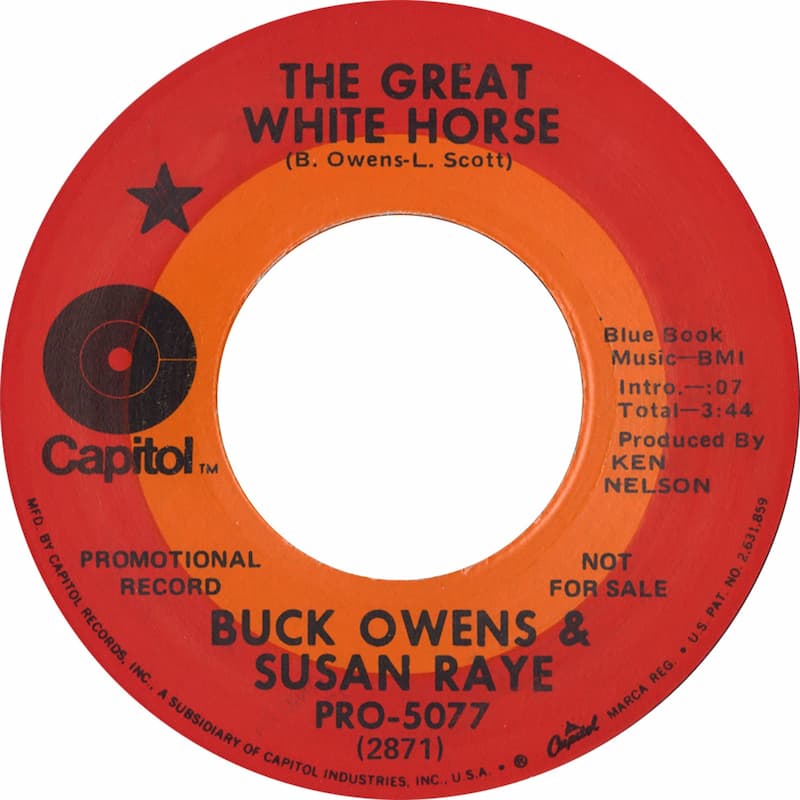
“The Great White Horse” is a duet recorded by Buck Owens and Susan Raye during the early 1970s, when both were key figures in the Bakersfield country scene and regular partners on records, television and tour dates. Issued on Capitol Records and credited to Buck Owens & Susan Raye, it belongs to the same period that produced other Owens–Raye collaborations such as “We’re Gonna Get Together” and “Togetherness,” reflecting his shift from purely solo singles to a more ensemble-focused presentation built around the Buckaroos and featured vocal partners.
The track was cut in Bakersfield, California, at Buck Owens’ own studio, using his road band rather than the large studio orchestras popular in Nashville at the time. Sessions from this era were typically overseen by longtime producer Ken Nelson alongside Owens himself, maintaining the lean, guitar-driven sound that had carried Buck through his 1960s Capitol hits. Susan Raye was by then an established member of the Buck Owens organization: she co-hosted segments on his syndicated TV show and recorded a string of solo singles, so giving her equal billing on a song like “The Great White Horse” was a natural extension of their working partnership.
On album, “The Great White Horse” appears in the cluster of early-’70s Owens releases that emphasize duets and strongly themed material. These LPs mixed solo Buck tracks with Owens–Raye duets, sometimes recycling successful singles and sometimes debuting new songs aimed at country radio. In that context, “The Great White Horse” stands out for its title and imagery, which lean more toward Western fantasy and symbolism than the straightforward honky-tonk subjects that dominated his 1960s output. The duet helped underline that Owens’ catalogue in this period was broadening beyond barroom laments and two-step shuffles into more story-driven material.
Lyrically, the song uses the image of a great white horse as a metaphor for escape and protection. The two singers trade lines about leaving behind a world of trouble and riding away together, trusting that this powerful, almost mythical animal will carry them to a better place. Verses touch on fear, uncertainty and the sense that everyday life has become too heavy to bear, while the chorus returns to the promise that, as long as they have each other and the great white horse, they can outrun whatever is chasing them. The duet format reinforces that idea: rather than one narrator guessing about a partner’s feelings, both voices are heard, agreeing to make that journey together.
Musically, “The Great White Horse” keeps one foot in Buck Owens’ classic Bakersfield sound and the other in the smoother early-1970s country-pop style. The rhythm section works in an easy mid-tempo groove, with drums, bass and bright electric guitars setting up the familiar West Coast drive. Steel guitar and occasional piano or organ fills add colour around the edges, but the arrangement remains relatively sparse compared with heavily orchestrated Nashville productions of the same period. The main focus is on the interplay of the two voices: Owens’ dry baritone and Susan Raye’s higher, clearer tone are balanced closely in the mix, so the story always feels like a conversation rather than a solo monologue.
Although “The Great White Horse” did not become as universally recognized as Owens’ 1960s smashes like “I’ve Got a Tiger by the Tail” or “Act Naturally,” it earned airplay on country radio and has remained part of the story of his early-’70s career. Compilations that explore his work with Susan Raye, as well as box sets that collect his Capitol recordings, often include the track to illustrate the duet side of the Bakersfield sound. For listeners who know Buck Owens mainly for hard-driving honky-tonk, the song offers a different angle: a slightly more cinematic, image-rich lyric sung by two voices in partnership, carried by the same tight band and clean production that defined his prime years.
In retrospect, “The Great White Horse” is often treated as a representative example of how Buck Owens adapted in the new decade without abandoning his core identity. The song retains his preference for concise writing, clear melodies and unadorned band arrangements, but the shared vocal and dream-like imagery point toward a broader idea of what a Buck Owens record could be. Together with other Owens–Raye collaborations, it shows how the Bakersfield sound could stretch to accommodate duets, narrative experiments and a slightly softer edge, while still sounding unmistakably like Buck Owens and the Buckaroos.
Video
Lyric
(When I was a young girl I used to dream of a lover
To be my shining knight of strength one day
He’d cary me to a castle in the heavens and battle all my dragons on the way
And he’d ride down on a great white horse he’d bring me love I was longing for
He’d bring me joy and lasting peace on a great white horse he’d ride away with me
Singing dumb-di-de-dumb-dumb-dumb-di-de-dum)
When I was a young man I used to dream of a maiden
With long soft hair flowing in the wind
Her laughing eyes and loving arms would follow
When I’d sail around the world and back again
And I’d ride down on a great white horse I’d bring the love she was longing for
I’d bring her laughter and sunny days
And on a great white horse I’d carry her away
Singing dumb-di-de-dumb-dumb-dumb-di-de-dumb
and I don’t wanna sail the seven seas
(Anywhere we are becomes our castle) and the only world I want is here with me
And we both ride on a great white horse we found the love we were longing for
(You’re my sunshine on a rainy day) you’re my April you’re my May
Singing dumb-di-de-dumb-dumb-dumb-di-de-dumb
Singing dumb-di-de-dumb-dumb-dumb-di-de-dumb
Singing dumb-di-de-dumb-dumb-dumb-di-de-dumb