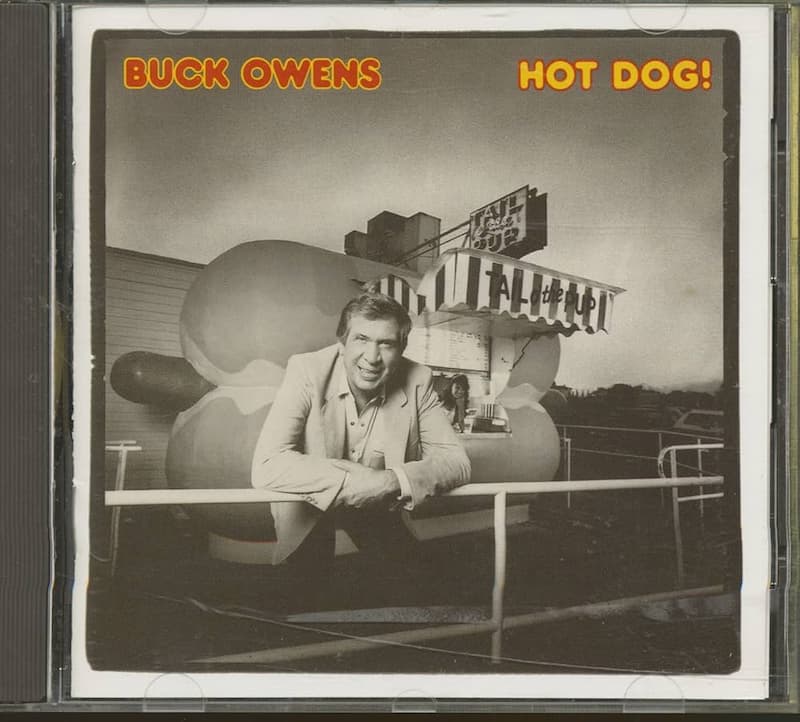
About The Song
“Hot Dog” is one of the most unusual records in Buck Owens’ career – a hard-charging rockabilly single he issued long before he became the king of Bakersfield country. Most discographies date the original release to early 1956, when a young Owens cut the song for the small Bakersfield label Pep Records. To avoid upsetting country DJs and club owners who disliked rock & roll, the record was issued under the pseudonym “Corky Jones,” with “Hot Dog” on one side and “Rhythm and Booze” on the flip. It did not chart nationally, but it picked up regional jukebox play on the West Coast and quietly became a cult favourite among early rock & roll collectors.
At the time, Owens was still working his way up as a local musician rather than a national recording star. He played guitar in Bakersfield bars and dancehalls, backed artists like Bill Woods and Tommy Collins, and worked radio and TV shows around California. Rockabilly – the raw, echo-soaked mix of hillbilly music and rhythm & blues – was in its first wave, and “Hot Dog” shows Owens trying that new style on for size. Compared with his later Capitol hits, the record sounds almost like a different artist: more slap-back echo, less polish, and a vocal that leans into teenage excitement rather than the tough, straight country style he would adopt in the 1960s.
The lyric is simple and very much of its time. The narrator brags about heading out on a Saturday night, meeting a girl, and dancing to loud music until late. Lines about “rockin’ and a-rollin’” and not caring what the neighbours think place the song firmly in the new youth culture that was forming around rock & roll in the mid-1950s. There is no heartbreak, no honky-tonk drama – just the thrill of fast music, a good dance partner and the feeling that, for a few hours, nothing else matters. That focus on fun was typical of early rockabilly 45s aimed at jukeboxes and teen dances rather than country radio.
Musically, “Hot Dog” is built on the classic rockabilly toolkit. A slapped upright-style bass, a snare drum backbeat and twanging electric guitar drive the track at a brisk tempo, with Owens’ vocal pushed forward and drenched in echo. The guitar work – often attributed to Owens himself in studio histories – alternates between sharp, clipped rhythm parts and quick single-note runs that answer the vocal lines. There are no fiddles or steel guitars, and no chorus vocals from a backing group; the sound is closer to Sun Records in Memphis than to the polished Nashville sessions that dominated country radio at the time.
For many years, “Hot Dog” was a near-forgotten footnote in Buck Owens’ story. After signing with Capitol and breaking through with country hits like “Second Fiddle,” “Under Your Spell Again” and “Act Naturally,” he concentrated on the Bakersfield sound – bright Telecaster leads, tight two-step rhythms and honky-tonk themes. The old Pep single remained out of print and was known mainly to collectors who hunted down obscure rockabilly 45s. Only when rockabilly revivalists in Britain and Europe began reissuing rare 1950s tracks in the 1970s did the Corky Jones record start appearing again on compilation LPs and later CDs.
The song’s second life was helped by the fact that other artists picked it up. British rock & roll and rockabilly performers, attracted by its simple structure and high energy, cut their own versions, and it eventually became better known in some circles through those covers than through Owens’ original 1956 recording. As interest in Bakersfield history grew, though, “Hot Dog” came to be seen as an important missing piece: evidence that Buck Owens had experimented with rock & roll very early, then stepped away from it when he realised his long-term future lay in country music. Modern box sets and career-spanning anthologies now routinely include the track, allowing listeners to hear how a future country legend once tried on the sound of teenage rockabilly before building the Bakersfield style that made him famous.
Video
Lyric
My baby works in a hot dog stand
Making them hot dogs as fast as she can
Up steps a cat and yells, “Don’t be slow
And get me two hot dogs ready to go”
Hot dog, she’s my baby
Hot dog, drives me crazy
Hot dog, I don’t mean maybe
You oughta see my baby at the hot dog stand
In the cool of the evening when the sun goes down
All the chicks and the cats all gather around
They order hot dogs and red soda pop
Then they head down the road to a hep cat hop
Hot dog, she’s my baby
Hot dog, drives me crazy
Hot dog, don’t mean maybe
You oughta see my baby at the hot dog stand
Well, I’m a-waiting for my baby every night at 12
She closes up the shop and then we lose ourselves
At a hep cat hop, in a crazy way
We’re a-doin’ the bop ’til the break of day
Hot dog, she’s my baby
Hot dog, drives me crazy
Hot dog, I don’t mean maybe
You oughta see my baby at the hot dog stand
Well, all the cats have been a hanging around
Trying to get my baby to put them down
She either don’t hear or she either don’t care
Or maybe it’s a way that apart my hair
Hot dog, she’s my baby
Hot dog, don’t mean maybe
Hot dog, drives me crazy
You oughta see my baby at the hot dog stand