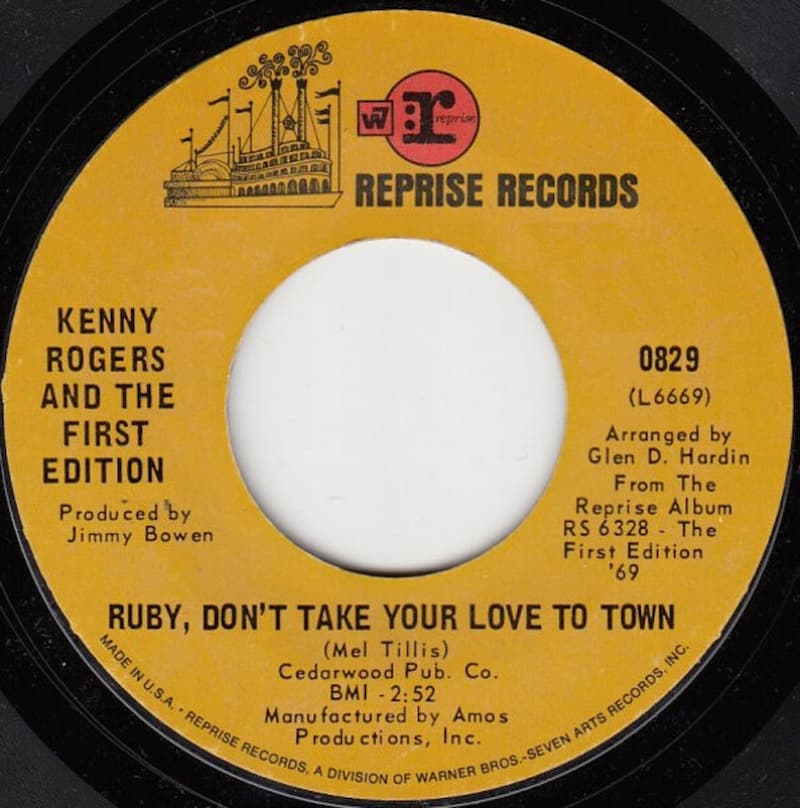
About The Song
“Ruby, Don’t Take Your Love to Town” is a song written by Mel Tillis that became one of the best-known recordings associated with Kenny Rogers and The First Edition. The composition tells the story of a paralyzed veteran who pleads with his wife, Ruby, not to seek affection elsewhere; its spare, direct lyric and emotionally stark premise made the song an immediate conversation piece when it circulated in the late 1960s. The tune was first recorded by other performers in the mid-1960s, and The First Edition’s dramatic single version, with Kenny Rogers on lead vocal, brought the song its greatest international exposure when released under the band’s name in 1969.
The First Edition recorded their version in a single-take session in mid-1968, aiming to move the group’s sound more toward country-tinged storytelling after earlier pop and psychedelic hits. Their arrangement emphasizes a rolling, train-like rhythm and a restrained acoustic foundation that keeps the focus on Rogers’s narrative delivery. The single closes with a spoken plea—an abrupt, humanizing moment that underlines the song’s desperation and helped distinguish the First Edition interpretation from earlier versions.
Mel Tillis’s lyric was widely interpreted at the time as connected to contemporary debates about war and returning veterans; Tillis himself has said the song’s subject was inspired by veterans of earlier conflicts. The narrator’s paralysis and inability to act produce a dramatic irony: he imagines violent retribution but is physically helpless, and the lyric’s moral weight rests on that contrast. The story’s compressed form—few characters, a single scene, and an urgent refrain—allows the listener to supply context and to read the song as both a personal tragedy and a social comment.
Commercially, the First Edition’s single became an international hit in 1969. It reached the Top 10 on the U.S. pop charts, climbed to number six on the Billboard Hot 100, and placed strongly on the Cash Box chart and adult-contemporary listings. The record achieved particularly high rankings in other countries, peaking at number two on the U.K. singles chart and reaching the top five in Canada and several other markets. On the U.S. country chart it registered more modestly, reflecting the group’s crossover positioning between pop, rock and country audiences.
The song has had a broad life in cover versions and reinterpretations across genres, which has helped sustain its profile over time. Country artists, pop acts and vocal interpreters have all recorded the song, and several notable versions followed the First Edition recording. Kenny Rogers later re-recorded the song for solo compilations, and its inclusion on retrospective collections has kept the track in circulation for listeners who know Rogers primarily from his later country-solo career.
Critically and culturally, “Ruby, Don’t Take Your Love to Town” is often cited as an example of late-1960s songwriting that married narrative directness to topical resonance. The First Edition version is remembered for its stark vocal reading and the production choices that foregrounded the story’s bleak emotional core. For Kenny Rogers, the single stands as an early high point that showcased his ability to carry a dramatic lyric; for listeners and historians it remains a potent, if unsettling, portrait of love, impotence and longing compressed into a three-minute single.
Video
Lyric
You’ve painted up your lips and rolled and curled your tinted hair
Ruby, are you contemplating going out somewhere?
The shadow on the wall tells me the sun is going down
Oh, Ruby
Don’t take your love to town
It wasn’t me that started that old crazy Asian war
But I was proud to go and do my patriotic chore
And yes, it’s true that I’m not the man I used to be
Oh, Ruby
I still need some company
It’s hard to love a man whose legs are bent and paralyzed
And the wants and the needs of a woman of your age, Ruby, I realize
But it won’t be long I’ve heard them say until I’m not around
Oh, Ruby
Don’t take your love to town
She’s leaving now ’cause I just heard the slamming of the door
The way I know I’ve heard it slam one hundred times before
And if I could move I’d get my gun and put her in the ground
Oh, Ruby
Don’t take your love to town
Oh, Ruby
For God’s sakes turn around