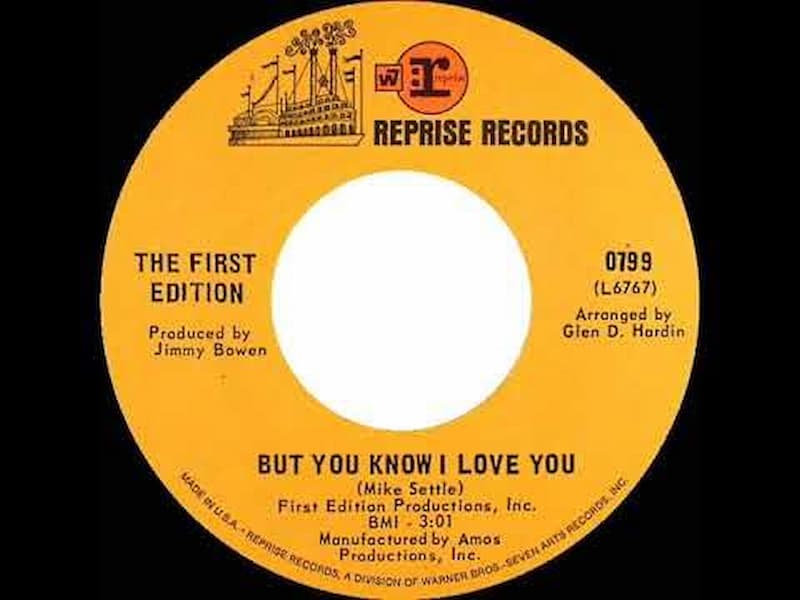
About The Song
“But You Know I Love You” is a song written by Mike Settle and first recorded by Kenny Rogers & The First Edition in late 1968, issued as a single and appearing on the group’s 1969 album often titled ’69. The tune blends country-folk sensibility with a pop arrangement typical of the group’s late-1960s output and featured Kenny Rogers on lead vocal; it became one of The First Edition’s charting singles in the period that followed their breakthrough hits.
The First Edition—Kenny Rogers’s band before his solo country stardom—operated at the crossroads of pop, country and rock. At the time the song was recorded, the group was broadening its repertoire beyond psychedelic and rock-tinged numbers toward material with more direct melodic hooks and country inflections. “But You Know I Love You” fit that strategy: its straightforward melody and travel-wearied narrator offered a different, more sentimental side of the group’s public persona while still allowing Rogers’s warm narrative delivery to lead the performance.
Musically the recording is arranged around a gentle, midtempo groove with brass and folk-tinged instrumentation undergirding the vocal. Lyrically the song adopts the viewpoint of a touring performer who acknowledges the strain that life on the road places on a relationship but affirms an enduring emotional bond—“but you know I love you.” The plainspoken lyric and clean melodic structure made the track adaptable to both pop and country interpretations and helped explain why other artists would cover it soon after its release.
On the pop charts the First Edition’s version reached the Top 20, peaking at about number 19 on the Billboard Hot 100 in early 1969; it also placed well in Canadian listings. The single’s commercial showing made it one of the group’s moderate hits between their most explosive single and their later signature recordings. Although not as explosive as some earlier or subsequent singles, its chart performance demonstrated the song’s broad audience appeal across North American pop and adult-contemporary outlets.
“But You Know I Love You” found a strong second life in country music through notable covers. Bill Anderson recorded a version that rose high on the country charts in 1969, and Dolly Parton’s 1981 recording reached number one on the Hot Country Singles chart, introducing the song to a new generation of country listeners. Numerous other artists across R&B, pop and country have recorded the tune, testifying to its flexible melody and emotionally direct lyric that suit varied vocal approaches.
Over time the song has become a durable item in the catalogs of performers who traverse genre lines: it appears on First Edition compilations and on retrospective collections for both Rogers and the other artists who covered it. For Kenny Rogers it is often noted as part of the transitional pre-solo phase—a recording that foreshadowed the narrative warmth and crossover instincts he would later exploit as a solo country star. The song’s continued presence on streaming playlists and reissue packages keeps it available to listeners tracing that career arc.
In short, “But You Know I Love You” stands as a concise, emotionally candid song whose appeal crossed pop and country boundaries. Its writer Mike Settle supplied a simple but effective lyric about distance, duty and reassurance, and The First Edition’s recording—anchored by Rogers’s voice—helped establish the song in the late 1960s. Subsequent country interpretations, especially Dolly Parton’s chart-topping cover, extended the track’s life and secured its place as a small classic of cross-format American songwriting.
Video
Lyric
When the morning sun
Streaks across my room
And I’m wakin’ up
From another dream of you
Yes I’m on the road
Once again it seems
All I’ve left behind
Is a chain of broken dreamsBut you know I love you
Yes, I love you
Whoa, I love youHow I wish that love
Was all we’d need to live
What a life we’d have
‘Cause I’ve got so much to give
And it seems so wrong
Deep inside my heart
That the dollar sign
Could be keeping us apartAnd if only I could find
My way back to the time
When the problems of this life
Had not yet crossed our minds
All the answers could be found
In children’s nursery rhymes
I’d come running back to you
I’d come running back to youBut you know we can’t
Live on dreams alone
And to pay the rent
I must leave you all alone
‘Cause you know I made my choice
Many years ago
Now this traveling life
Is the only one I know