About The Song
“Pretend I Never Happened” sits right at the turning point between Waylon Jennings the Nashville insider and Waylon Jennings the full-blown outlaw. Written by Willie Nelson, the song was cut by Jennings for RCA Victor and issued as a single in 1972, several months before it turned up on the 1973 album Lonesome, On’ry and Mean. At just about three minutes long, it became a Top 10 country hit in the U.S. and a bigger success in Canada, proof that even before the outlaw image was fully in place, listeners were ready for this kind of plainspoken emotional wreckage.
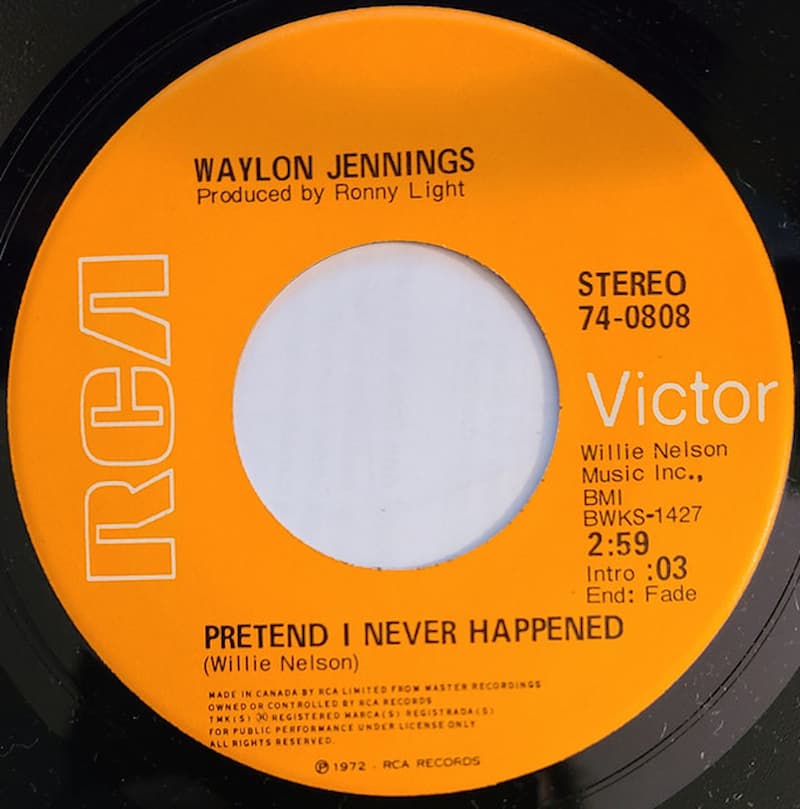
Session logs and fan histories place the recording at RCA Studio B in Nashville on May 16, 1972, with Ronny Light producing under the old label system. Released later that year on RCA Victor as a 7-inch single (catalog 74-0808), it was backed with the non-album cut “Nothin’ Worth Takin’ or Leavin’” and marketed as part of Jennings’ steady run of hits. The following March, when Lonesome, On’ry and Mean arrived as his first album under a new, more artist-friendly contract, “Pretend I Never Happened” was folded into the track list, an earlier recording now repurposed inside what many critics see as his first truly classic outlaw LP.
The song’s roots go back to Willie Nelson, who wrote it during the years when his compositions were often more successful in other people’s hands than in his own. Lists of Nelson’s songwriting credits place “Pretend I Never Happened” alongside standards like “Pretty Paper” and “The Party’s Over,” and he later reclaimed it for his 1974 concept album Phases and Stages, a cycle about a divorce told from both sides of a broken marriage. In that setting, the song becomes part of the woman’s chapter, another piece of evidence in a long, painful separation. For Willie, it was one more example of a brutally honest lyric the Nashville establishment did not quite know what to do with until a singer like Waylon picked it up.
The story inside the song is devastatingly simple. A man is leaving and, instead of promising to write or asking to be remembered fondly, he tells his former lover that the healthiest thing she can do is erase him from her mind. He calls his own love cold, assumes she will find ways to be happy without him, and insists that if his memory ever surfaces she should treat it like something that never really existed in the first place. Rather than blaming her, the narrator shoulders the guilt and asks to be wiped out, which makes the song feel less like a typical breakup number and more like a guilty confession delivered at the station just before the train pulls out.
Jennings’ performance drives the point home. His baritone is calm and steady, almost conversational, as if he has rehearsed this speech in his head a hundred times and finally reached the moment he has to say it out loud. The arrangement is classic early-’70s country: firm backbeat, pedal steel curling around the vocal, electric and acoustic guitars filling in the gaps without ever getting in the way. Ronny Light’s production is cleaner and more traditional than the tougher sound Waylon would soon chase on his self-produced sessions, but there is still a rough, lived-in quality to the track that keeps it from feeling polished or sentimental.
On the charts, “Pretend I Never Happened” did more than just keep his name on the radio. The single climbed to No. 6 on the Billboard Hot Country Singles chart and reached No. 2 on Canada’s RPM country survey, giving Jennings a solid hit at a moment when his health, finances and relationship with RCA were all under strain. When Lonesome, On’ry and Mean followed and made the country albums Top 10, listeners could hear the song in a new context: not just as another heartache single, but as part of an album that announced Waylon’s demand for creative control and helped define the outlaw movement that would dominate his mid-seventies career.
The afterlife of the song has been surprisingly rich. It appears on major retrospectives like the box set Nashville Rebel and The Essential Waylon Jennings, ensuring that new fans who start with compilations still stumble across it. Willie Nelson has continued to champion the tune, singing it himself onstage and on record, and in 2023 he even cut a warmly harmonized duet version with his daughter Paula, who called it one of her favorite songs her father ever wrote. Younger acts such as Bill and the Belles have also covered it, treating it as a modern standard. All of that attention underscores what Jennings heard back in 1972: beneath its modest length and gentle tempo, “Pretend I Never Happened” is a stark, unforgettable piece of country storytelling that ties together two of the genre’s most enduring rebels.
Video
Lyric
Pretend I never happened
Erase me from your mind
You will not want to remember
Any love as cold as mine
I’ll be leaving in the morning
For a place I hope I find
All the places must be better
Than all the ones I leave behind
I don’t suppose you’ll be unhappy
You’ll find ways to spend your time
But if you ever think about me
And if I ever cross your mind
Pretend I never happened
Erase me from your mind
You will not want to remember
Any love as cold as mine
I don’t suppose you’ll be unhappy
You’ll find ways to spend your time
But if you ever think about me
And if I ever cross your mind
Pretend I never happened
Erase me from your mind
You will not want to remember
Any love as cold as mine