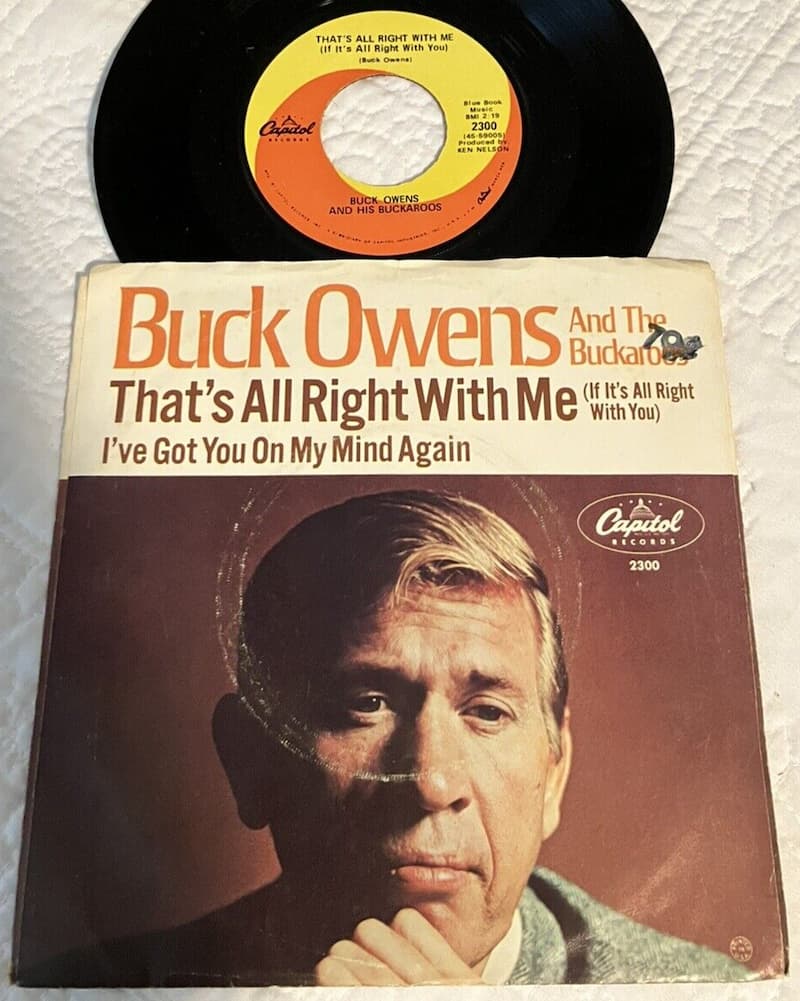
About The Song
“I’ve Got You on My Mind Again” is a late-1960s single by Buck Owens and His Buckaroos, written by Owens and released on Capitol Records. Discography and label sources list it as Capitol 2300, a 7-inch 45 issued in the United States on September 30, 1968, with “That’s All Right with Me (If It’s All Right with You)” on the B-side. The track also served as the title song of Owens’ 1968 studio album I’ve Got You on My Mind Again, giving the project a central ballad that radio could pick up as a separate single.
The album I’ve Got You on My Mind Again was released by Capitol on December 30, 1968, credited to Buck Owens and His Buckaroos. It contains 12 tracks and runs just under half an hour. Reissue and catalogue notes emphasise that 11 of the 12 songs were written entirely by Owens, underlining how much original material he was generating at this stage of his career. The LP also features two duets with his son Buddy Alan, including “Let the World Keep On a Turnin’,” which became a separate hit in its own right. On the charts the album reached No. 19 on Billboard’s Top Country Albums and made a brief appearance on the Billboard 200, peaking at No. 199, giving Owens another Top 20 country LP in 1968.
The single “I’ve Got You on My Mind Again” appeared in the middle of a very strong year for Owens. According to chart summaries, all four of his 1968 singles – “How Long Will My Baby Be Gone,” “Sweet Rosie Jones,” the duet “Let the World Keep On a Turnin’” and “I’ve Got You on My Mind Again” – reached the U.S. country Top Ten, and all but one made the Top Five. The title track itself peaked at No. 5 on the Billboard Hot Country chart and also reached the country Top Ten in Canada. Year-end listings rank it among the notable country songs of 1968, reflecting steady airplay rather than a short, sudden spike. Playback.fm, which compiles historical radio and sales data, places it around No. 56 on its 1968 country ranking.
Lyrically, the song is a straightforward reflection on lingering attachment after a breakup. The narrator admits that he promised himself he would forget and never look back, but as each long day ends and “the lonely night begins,” he finds that he still has the other person on his mind. Lines refer to the return of the “same old hurt” that has been present since the moment she walked out the door. The lyric does not dwell on specific incidents or arguments; instead it focuses on the recurring, almost routine nature of missing someone, and the way that unresolved feelings return at night even when a person tries to move on.
Musically, “I’ve Got You on My Mind Again” marks a slight stylistic shift from Owens’ earlier, harder Bakersfield hits. Reissue essays and reviews describe it as a ballad built around saloon-style piano, steel guitar and a more polished arrangement than his early-1960s work. Background vocals from Nashville-style singers such as the Jordanaires and bass vocalist Ray Walker (often referred to in notes simply as “Kerr” as part of the vocal team) give the chorus a smoother texture associated with the Nashville Sound. At the same time, the core of the track – clear rhythm section, prominent lead vocal and concise running time of about 2:25 – remains consistent with Owens’ established approach.
The album as a whole is often cited as a modest departure from the rawer Bakersfield sound that had defined Owens’ mid-1960s run. Commentary on Omnivore’s 2021 reissue points out that he experimented with lusher arrangements and even occasional string parts across the LP, while keeping his songwriting direct and accessible. Within that context, “I’ve Got You on My Mind Again” functions as the key slow number, balanced by faster tracks such as “Sing a Happy Song” and the duet “Let the World Keep On a Turnin’,” which bring Buckaroos-style drive back into the sequence. This alternation between ballads and uptempo material is a consistent feature of the album’s running order.
In the longer view of Owens’ career, “I’ve Got You on My Mind Again” is remembered as part of the transition from his mid-1960s string of No. 1 singles to a slightly more varied late-1960s catalogue. The song appears on later compilations and box sets that survey his Capitol years, and its title has been reused for CD and digital reissues of the original 1968 album. For listeners and historians, it illustrates how Owens could adapt elements of the smoother Nashville Sound—piano, vocal choruses and a softer overall feel—without completely abandoning the concise writing and clear melodic focus that had made him one of the defining figures of the Bakersfield movement.
Video
Lyric
I’ve got you on my mind again
You’ve been there since I don’t know when
I said that I’d forget, that I’d never look back
That I’d find somebody else so little further down the track
But that same old hurt is back once more
It’s certain you walked out the door
And as the long day ends and the lonely night begin
I’ve got you on my mind again
Well, I said that you’d be out of mind
When you’ve got out of sight
That there’d never be one lonely moment
Or one sleepless night
But lately I’ve been finding out
Just what a heartache means
For every time I close my eyes
I see you in my dreams
And I’ve got you on my mind again
You’ve been there since I don’t know when
I said that I’d forget, and I’d never look back
That I’d find somebody else so little further down the track
But that same old hurt is back once more
It’s certain you walked out the door
And as the long day ends and the lonely night begin
I’ve got you on my mind again
I’ve got you on my mind again