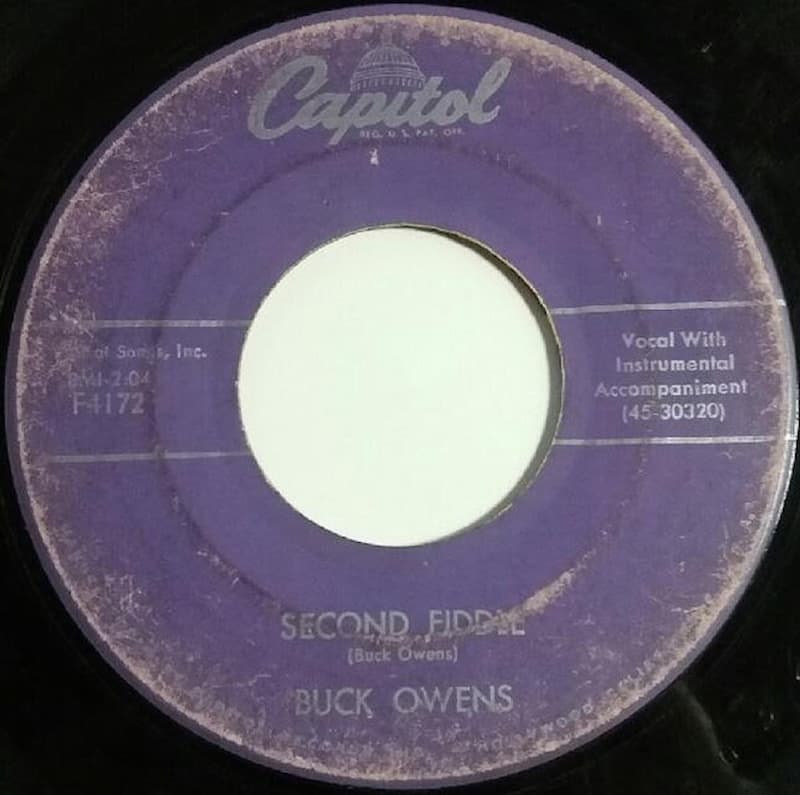
About The Song
“Second Fiddle” is an early Buck Owens single written by Owens himself and released on Capitol Records in 1959. Discography and label sources list it as Capitol 4172, backed with “Everlasting Love.” The track was recorded in Hollywood at Capitol Recording Studio with producer Ken Nelson, during sessions in late 1958, and issued as a 7-inch 45 in the spring of 1959. Contemporary notes and later biographies describe it as Owens’ first solo hit after several earlier singles had failed to chart, marking the real beginning of his national recording career.
Chart records show that “Second Fiddle” became Owens’ first entry on the U.S. Billboard country chart. In May 1959 it climbed to No. 24 on the Hot Country & Western Singles listing, giving him a modest but significant breakthrough after several years working as a session guitarist and regional performer on the West Coast. Later summaries of his career routinely point to this record as the turning point that led to stronger follow-up singles such as “Under Your Spell Again,” which reached the country Top 5 later the same year.
The recording belongs to Owens’ pre-Bakersfield peak but already shows elements of the style he would refine in the 1960s. Accounts from critics and historians call “Second Fiddle” a straight Ray Price–style shuffle, with Owens’ vocals reflecting some of the phrasing and emotional edge associated with George Jones. Nelson, who had been cautious about allowing Owens to use honky-tonk instrumentation, finally let him bring in steel guitar and fiddle for this single, giving it a fuller, more traditional country sound than his earlier, less successful Capitol releases.
On album, “Second Fiddle” later appeared on Owens’ self-titled Capitol LP Buck Owens, released in 1961. Track listings for that album place it alongside other early singles such as “Under Your Spell Again,” “Above and Beyond” and “Excuse Me (I Think I’ve Got a Heartache),” effectively gathering his first run of Capitol hits into one package. Because of that, the LP has often been described in reissue notes as a snapshot of his transition from sideman and regional act to a nationally recognized artist with a distinct West Coast sound.
The lyric of “Second Fiddle” is built around a simple, memorable image. The narrator complains that he is always playing “second fiddle” to someone else in his lover’s life, just as he has in past relationships. He asks if there will ever be a day when he does not have to play that part, expressing both resignation and quiet frustration. Lines about “all the others” he has played for and the desire to be first in someone’s heart give the song a clear emotional focus: a man who knows he is being taken for granted but stays anyway.
Musically, the track is concise and radio-friendly, running a little over two minutes. A shuffled rhythm, walking bass and brushed snare drum support Owens’ vocal, while steel guitar and fiddle provide fills between lines. Compared with the string-laden Nashville productions of the same era, the arrangement is relatively lean: a small band, clear beat and unvarnished instrumentation. Later critics have pointed out that, although Owens’ fully developed Bakersfield sound would not emerge until the early 1960s, the unpolished drive and straightforward playing on “Second Fiddle” already set him apart from mainstream Nashville records.
In retrospect, “Second Fiddle” is often treated as a “quiet breakthrough.” It did not reach the Top 10, but it opened the door at Capitol by proving that Owens’ own songs and lead vocals could chart. Biographical pieces emphasize that after this single, the label and producer Ken Nelson grew more confident in giving him artistic freedom, leading to stronger, more distinctive records from 1959 onward. Within his catalogue, the song remains important not as a major hit but as the first step in the run of country singles that would eventually make Buck Owens one of the central figures of the Bakersfield sound.
Video
Lyric
I’ll play second fiddle to your new love while it lasts
Just like all the others I’ve played for in the past
Why can’t I be a leader and play your leading part?
Why must I always have to play second fiddle in your heart?
Play fiddle play
Will there never come a day
When I won’t have to play the part
Of second fiddle in your heart?
Each time you find a new love, you leave me here to cry
The teardrops tell a story, of a love that just won’t die
Like an early mornin’ paper, the news you get just part
Why must I always have to play second fiddle in your heart?
Play fiddle play
Will there never come a day
When I won’t have to play the part
Of second fiddle in your heart?