About The Song
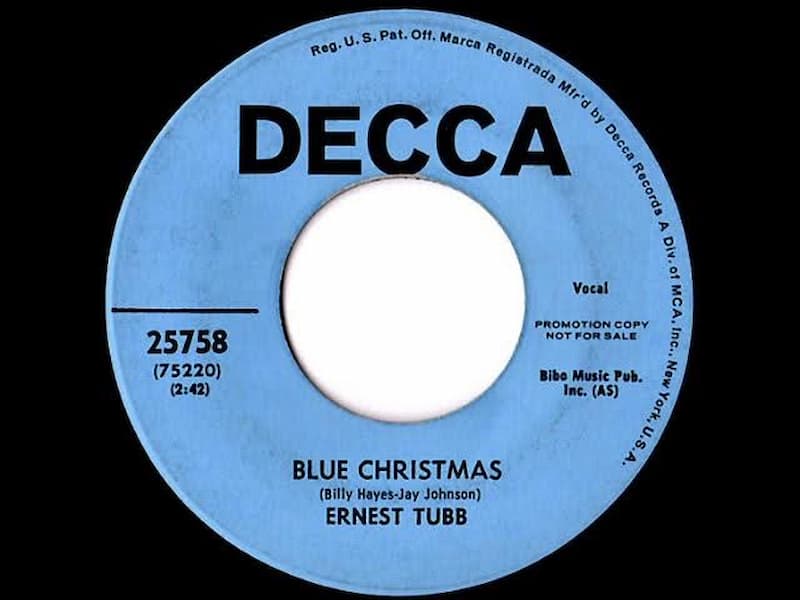
“Blue Christmas” is a Christmas song written by Billy Hayes and Jay W. Johnson, made into a major country hit by Ernest Tubb in 1949. Tubb recorded the song for Decca Records, issued on 78 rpm single Decca 46186 with “White Christmas” on the flip side. Discography and release data place the recording on August 26, 1949, with the single reaching the market in the autumn of that year, just ahead of the 1949 holiday season. The track is generally classified as country, honky-tonk and Christmas music.
The composition itself predates Tubb’s version. Hayes and Johnson wrote “Blue Christmas” in 1948, and the first known recording was by Western singer Doye O’Dell that same year. In 1949 it was picked up by several artists in different styles, including country (Ernest Tubb), big-band pop (Hugo Winterhalter and his orchestra) and dance-band pop (Russ Morgan and his orchestra). These parallel releases helped establish the song as a new seasonal standard, with Tubb’s interpretation providing the key entry point for country audiences.
Ernest Tubb’s recording was cut as part of his regular Decca sessions, aimed at the growing post-war country market. Contemporary discographies identify the disc as Decca 46186, released in the U.S. with “White Christmas” on one side and “Blue Christmas” on the other. The single appears in 1949 country-music listings with an August 26 recording date and an October release date, indicating that Decca positioned it specifically for the year-end season. Later vinyl reissues in the 1950s and 1970s kept the same pairing and catalogue association.
Lyrically, “Blue Christmas” is a holiday-themed song about unrequited love. The narrator anticipates a “blue” Christmas without the person he loves, imagining decorations, parties and celebrations that will feel empty in that absence. The text contrasts images of traditional holiday cheer—lights, snow, greeting cards—with the emotional distance between the singer and the person addressed. The core theme is loneliness during a time normally linked with togetherness, which gave the song a different tone from more conventional, upbeat Christmas material of the late 1940s.
Musically, Tubb’s version presents the song as a mid-tempo honky-tonk ballad. The arrangement uses typical late-1940s country instrumentation: acoustic rhythm guitar, electric guitar, steel guitar, bass and simple percussion, with Tubb’s baritone voice front and center. Accounts of the single describe it as firmly in the honky-tonk tradition, but adapted to seasonal subject matter rather than barroom themes. Compared with later rock-and-roll interpretations, the Decca recording is relatively understated, leaning on Tubb’s relaxed phrasing and the steel-guitar fills to underline the “blue” mood suggested by the lyric.
On the charts, Ernest Tubb’s “Blue Christmas” was an immediate success. Billboard data summarized in song histories show that his version spent the first week of January 1950 at No. 1 on the magazine’s Most-Played Juke Box (Country & Western) Records chart, and country discographies list it as a No. 1 country hit for 1949 with additional re-entries in 1950 and 1952, when it again reached the Top 10 on the U.S. country charts. The same sources note crossover activity on national pop listings, where the record reached the lower region of the Top 30, confirming its appeal beyond strictly country programming.
The song’s later history has been shaped by subsequent recordings, most famously Elvis Presley’s 1957 rock-and-roll version, which became the best-known interpretation in popular culture. However, reference works and song histories consistently credit Ernest Tubb’s Decca 46186 single as the recording that first made “Blue Christmas” a national hit and fixed it in the country Christmas repertoire. Tubb later revisited the song on his 1964 Decca album Blue Christmas, a full-length seasonal LP that helped keep the track in circulation on radio and on reissue compilations, where it continues to appear alongside other mid-century country Christmas recordings.
Video
Lyric
I’ll have a blue Christmas without you
I’ll be so blue thinking about you
Decorations of red on a green Christmas tree
Won’t mean a thing, dear, if you’re not here with me
I’ll have a blue Christmas, that’s certain
And when that blue heartache starts hurting
You’ll be doing alright with your Christmas of white
But I’ll have a blue, blue ChristmasI’ll have a blue Christmas, I know, dear
I hope your white Christmas brings you cheer
And when you say your prayers on this Christmas Eve
Will you feel the same, dear, as when you prayed with me?
And when those blue snowflakes start falling
That’s when those blue memories start calling
You’ll be doing alright with your Christmas of white
But I’ll have a blue, blue Christmas