About The Song
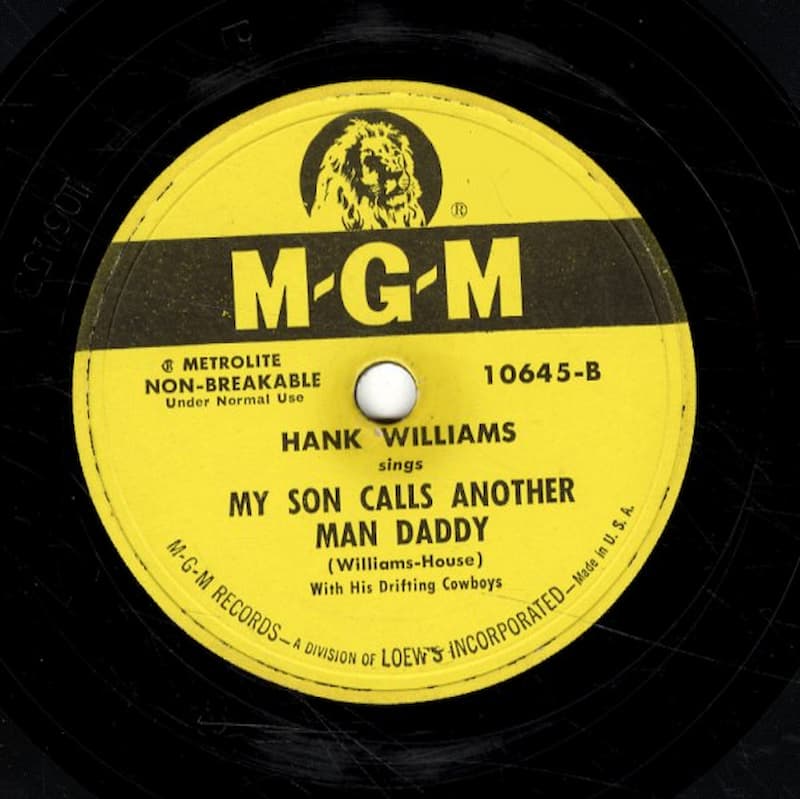
“My Son Calls Another Man Daddy” is a country song written by Jewell House and recorded by Hank Williams with His Drifting Cowboys for MGM Records. Williams first attempted the song at a session on March 2, 1949 in Nashville, but that early version was not issued. He returned to it on January 9, 1950 at Castle Studio in the Tulane Hotel, Nashville, with producer Fred Rose overseeing the date. The track was published by Acuff-Rose on November 25, 1949 and released in March 1950 as the B-side of the single “Long Gone Lonesome Blues” on MGM K10506.
Jewell House was a Texarkana-based musician and entrepreneur who hosted the Hayloft Jamboree radio show and ran Jewell’s Record Shop and Fun House. His composition fits the sentimental style associated with Roy Acuff, one of Williams’s major influences. Like “Wedding Bells” and “I’ve Just Told Mama Goodbye,” the song uses a highly emotional situation—here, a father separated from his child—to connect with audiences. Although Williams received a share of the writing credit on some listings, published sources identify House as the originator of the song.
The successful January 9, 1950 session brought Williams together with the players who would form the core of his early-1950s sound. Documentation lists Jerry Rivers on fiddle, Don Helms on steel guitar, Bob McNett on lead guitar, Jack Shook on rhythm guitar and Ernie Newton on bass, with Rose producing. The same date also produced “Long Gone Lonesome Blues,” “Why Don’t You Love Me” and other key titles. The recording of “My Son Calls Another Man Daddy” runs around two and a half minutes and is usually classified as hillbilly, honky-tonk and country blues.
Lyrically, the song is voiced from the perspective of a man who has been in prison and lost contact with his family. He imagines his young son now being raised by another man and refers to the moment he learns that “my son calls another man daddy.” Verses describe his sorrow, his memories of the child as a “ray of sunshine” in dark times and the pain of knowing that his son will never know his real father’s name or face. The text draws on familiar country themes of incarceration, broken homes and irreversible loss, expressed in simple, direct language.
Musically, the track is a slow to mid-tempo country ballad built on a straightforward chord progression. Acoustic guitar and bass provide a steady foundation while Rivers’s fiddle and Helms’s steel guitar add restrained fills between Williams’s vocal lines. Rose’s production leaves the arrangement sparse, emphasizing the lyric and vocal delivery. The performance reflects the influence of earlier sentimental songs in the Grand Ole Opry tradition but framed within Williams’s honky-tonk sound, making it suitable for both jukeboxes and radio.
On release, “My Son Calls Another Man Daddy” benefited from being paired with a major hit. “Long Gone Lonesome Blues” became Williams’s second No. 1 country single and spent twenty-one weeks on the Billboard Country & Western chart, with five weeks at the top. The B-side also charted in its own right, reaching No. 9 on the country singles listings in 1950. This made it one of several Hank Williams records from that period where both sides of the single received significant attention from listeners and disc jockeys.
Over time, the song has remained part of the Hank Williams catalogue through reissues and cover versions. It appears on compilations such as 40 Greatest Hits and broader anthologies of his 1949–1951 recordings. Later artists including Charley Pride, Willie Nelson and David Allan Coe have recorded their own versions, often as part of tributes to Williams. For historians and listeners, “My Son Calls Another Man Daddy” stands as a prominent example of the deeply sentimental, family-centered material that coexisted with Williams’s honky-tonk drinking songs and helped define the emotional range of his early-1950s output.
Video
Lyric
Tonight my head is bowed in sorrow
I can’t keep the tears from my eyes
My son calls another man daddy
The right to his love I’ve been denied
My son calls another man daddy
He’ll ne’er know my name nor my face
God only knows how it hurts me
For another to be in my place
Each night I laid there in prison
I pictured a future so bright
For he was the one ray of sunshine
That shone through the darkest of nights
Today his mother shares a new love
She just couldn’t stand my disgrace
My son calls another man daddy
And longs for the love he can’t replace
My son calls another man daddy
He’ll ne’er know my name nor my face
God only knows how it hurts me
For another to be in my place