About The Song
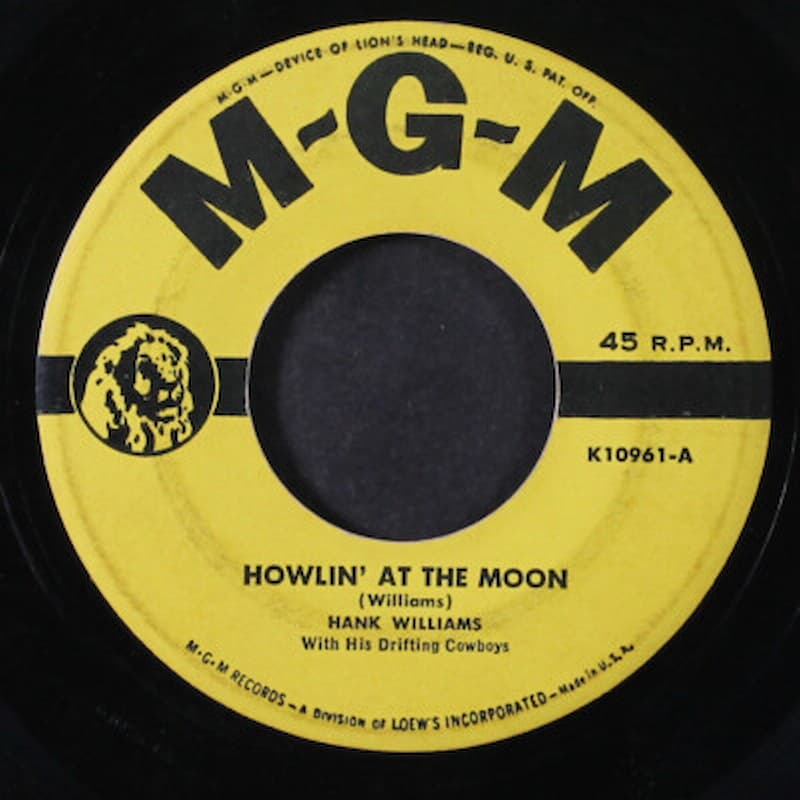
“Howlin’ at the Moon” is a 1951 single written and recorded by Hank Williams with His Drifting Cowboys for MGM Records. The song was recorded at Castle Studio in Nashville, Tennessee, on March 16, 1951, with longtime producer Fred Rose supervising the session. It was published by Acuff-Rose on April 23, 1951 and released shortly afterward as MGM single 10961, with the ballad “I Can’t Help It (If I’m Still in Love with You)” on the B-side. Classified as hillbilly, honky-tonk and country blues, the track runs about two minutes and forty-five seconds and reflects Williams’s up-tempo jukebox style of the early 1950s.
The single appeared at a key point in Williams’s career. Earlier in 1951 he had already scored a major hit with “Cold, Cold Heart,” and within months he would release “Hey, Good Lookin’.” Discographies show that the March 16 session that produced “Howlin’ at the Moon” also yielded “I Can’t Help It (If I’m Still in Love with You)” and “My Heart Would Know,” making it one of his most productive recording dates. All of these sides were cut at Castle Studio with Williams fronting his Drifting Cowboys band, continuing the partnership with Fred Rose and Acuff-Rose Publishing that had shaped his run of MGM singles.
Session information indicates that Williams was backed by Jerry Rivers on fiddle, Don Helms on steel guitar, Sammy Pruett on electric guitar, Jack Shook on rhythm guitar and either Ernie Newton or Howard “Cedric Rainwater” Watts on bass, with piano played by Owen Bradley or possibly Rose himself. The finished recording is fast and tightly arranged, with the rhythm section driving the tempo while fiddle and steel guitar trade short fills between vocal lines. Writer Colin Escott has described the performance as one that “tears along” and notes that it was only a short step from this sound to the rockabilly style that would emerge a few years later.
Lyrically, “Howlin’ at the Moon” portrays the exaggerated giddiness of being in love. The narrator insists that he is in such an “awful shape” that he can no longer spell his name, tries to eat a steak with a tablespoon and behaves more like a hunting dog than a human being. Repeated phrases about “chasing rabbits,” “scratching fleas” and “howlin’ at the moon” combine romantic infatuation with cartoonish hunting imagery. Commentators have pointed out that the lyric reflects Williams’s sense of humor and his interest in hunting culture, using those themes to depict how completely he has lost his composure over his sweetheart. The effect is light and comic rather than melancholy, contrasting with many of his better-known heartbreak ballads.
The recording also includes a distinctive sonic detail: the title phrase is punctuated by “hound dog” yelps voiced by fiddler Jerry Rivers, giving the track an additional layer of novelty. Despite this playful element, the core structure is straightforward country and western, built on a simple chord progression and common-time backbeat suited to dance halls and jukeboxes. This blend of humor, brisk tempo and tight ensemble playing has led some historians to cite the song as an example of Williams pushing honky-tonk toward the rhythmic feel later associated with early rock and roll.
On release in 1951, “Howlin’ at the Moon” rose to No. 3 on the U.S. Billboard country singles chart, giving Williams another Top 5 hit. Interestingly, its B-side “I Can’t Help It (If I’m Still in Love with You)” actually charted slightly higher, reaching No. 2 on the same listings, so the single effectively delivered a double success. Later reissues and compilations often present the two songs together to highlight this pairing of an up-tempo, humorous A-side with a more reflective ballad on the flip.
Over time, “Howlin’ at the Moon” has remained part of the core Hank Williams catalogue. It appears on his 1952 LP Moanin’ the Blues and has been included on numerous later collections, such as expanded editions of that album and multi-disc retrospectives covering the 1947–1951 period. The song has been covered by artists including George Jones, who recorded it for his 1960 tribute album George Jones Salutes Hank Williams, and it has been performed by later members of the Williams family in live and recorded settings. The original recording has also been used in media, including on the soundtrack of the television series For All Mankind, helping introduce the track to new audiences beyond country specialists.
Video
Lyric
I know there’s never been a man in the awful shape I’m in
I can’t even spell my name, my heads in such a spin
Today I tried to eat a steak with a big old tablespoon
You got me chasing rabbits, walkin’ on my hands, and howlin’ at the Moon
Well, sug’, I took one look at you and it almost drove me mad
And then I even went and lost what little sense I had
Now I can’t tell the day from night, I’m crazy as a loon
You got me chasing rabbits, pulling out my hair, and howlin’ at the Moon
Some friends of mine asked me to go out on a huntin’ spree
‘Cause there ain’t a hound dog in this state that can hold a light to me
I eat three bones for dinner today, then tried to tree a ‘Coon
You got me chasing rabbits, scratching fleas, and howlin’ at the Moon
I rode my horse to town today and a gas pump we did pass
I pulled ‘im up and I hollered, “Whoa!” And said, “Fill him up with gas”
The man picked up a monkey wrench and wham, he changed my tune
You got me chasing rabbits, spittin’ out teeth, and howlin’ at the Moon
I never thought in this whole world a fool could fall so hard
But honey baby, when I fell, the whole world must have jarred
I think I’d quit my doggish ways if you’d take me for your groom
You got me chasing rabbits, pickin’ out rings, and howlin’ at the Moon