About The Song
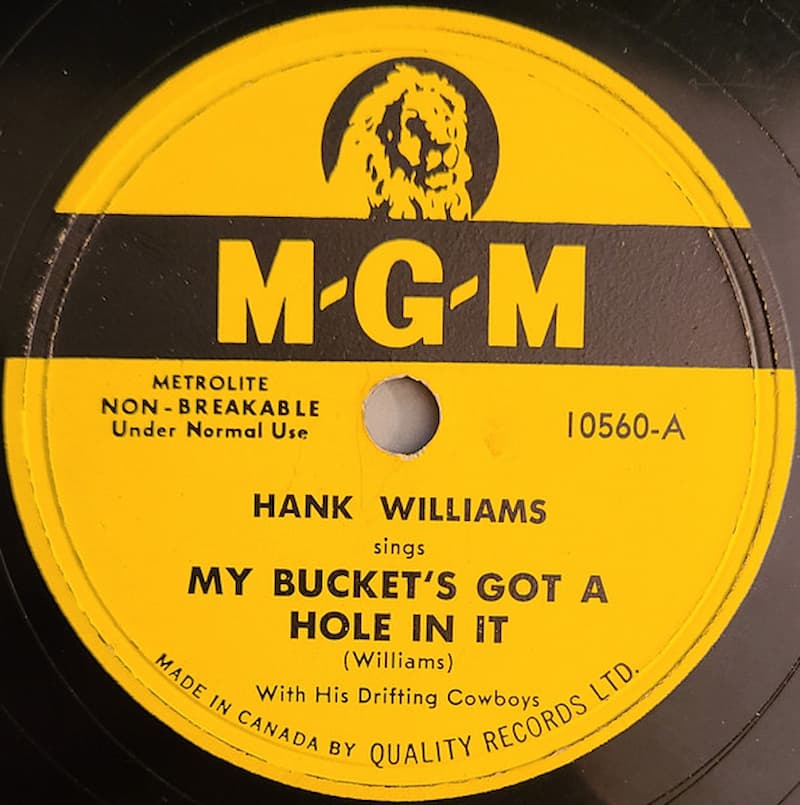
“My Bucket’s Got a Hole in It” is a country and blues song most closely associated with Hank Williams, although it was not written by him. The composition is widely credited to jazz pianist and songwriter Clarence Williams, who secured copyright on the title in 1933, but the melody and refrain had circulated under various names for decades beforehand. Williams recorded his version for MGM with His Drifting Cowboys at Herzog Studio in Cincinnati, Ohio, on August 30, 1949. Issued by MGM as single 10560 on November 8, 1949, with “I’m So Lonesome I Could Cry” on the B-side, the record became a Top 5 hit on the Billboard country charts later that year.
The song’s roots pre-date commercial country music. Music historians trace the melody back to the First World War-era piece “Long Lost Blues” and to a floating motif heard in early blues and jazz records such as “The Bucket’s Got a Hole in It” by Tom Gates & His Orchestra in 1927. Clarence Williams’s 1933 copyright formalised the title and structure, and bluesman Washboard Sam recorded a version in 1937. By the time Williams cut his MGM single in 1949, the tune was already part of a broader American vernacular tradition rather than a newly written pop song.
Hank Williams is believed to have learned the song from Rufus “Tee Tot” Payne, an African American street musician in Alabama who taught him blues guitar when he was young. In later interviews, Williams described following Payne around, paying with small amounts of money or food in exchange for lessons. Biographers and discographers point to “My Bucket’s Got a Hole in It” as one of the clearest examples of that early blues influence in his recorded work. Producer Fred Rose initially hesitated to release the song, partly because the original lyric mentioned beer and partly because it was not published by the Acuff-Rose company, but he eventually agreed after some lines—such as a reference to a Ford car—were removed.
The recording session on August 30, 1949 brought Williams together with musicians associated with the Pleasant Valley Boys. Documentation lists Zeke Turner on lead guitar, Jerry Byrd on steel guitar, Louis Innis on rhythm guitar, Tommy Jackson on fiddle and Ernie Newton on bass. The date also produced “I’m So Lonesome I Could Cry,” later regarded as one of Williams’s signature compositions. Notably, the MGM master of “My Bucket’s Got a Hole in It” includes the only guitar solo Williams is known to have recorded on his own records, a short, relaxed break that matches the song’s swinging, blues-based feel.
Musically, the track is described as honky-tonk, blues and proto-rockabilly. It uses a simple, repetitive structure with a strong backbeat and prominent steel and fiddle fills. Lyrically, the narrator complains that he cannot buy beer because his bucket—standing in for his finances or his luck—has “a hole in it.” The verses revolve around this image rather than a detailed storyline, allowing the performance and rhythm to carry much of the impact. Commentators have linked the record to other Williams titles such as “Move It On Over” and “Honky Tonk Blues” in showing how he blended country instrumentation with phrasing and motifs drawn from African American blues.
On release in late 1949, the single performed strongly on the country charts. Contemporary Billboard listings and later reconstructions generally place Hank Williams’s version near the top of the Country & Western best-seller and jukebox charts, around the Top 5, while uDiscover Music notes that it was engaged in a “battle of the buckets” with a competing version by T. Texas Tyler, with Williams’s recording finishing higher. Over the following years, the song attracted numerous covers: Louis Armstrong recorded it in 1950, and Ricky Nelson turned it into a multi-chart pop, R&B and country hit in 1958. These versions underline how a tune rooted in early jazz and blues could move easily into rock-and-roll and pop contexts.
In Hank Williams’s own catalogue, “My Bucket’s Got a Hole in It” stands out as an early demonstration of his ability to bring older material into a modern honky-tonk framework. The recording has been reissued on collections such as Honky Tonkin’, 40 Greatest Hits and various box sets, keeping it available alongside his original compositions. For historians and listeners, it illustrates both the depth of his blues education and the porous boundary between jazz, blues and country in mid-century American music, showing how a pre-war street and dance-hall tune could become a post-war country hit through Williams’s voice and band.
Video
Lyric
Yeah, my bucket’s got a hole in it
Yeah, my bucket’s got a hole in it
Yeah, my bucket’s got a hole in it
I can’t buy no beer
Well, I’m standin’ on a corner
With a bucket in my hand
I’m waitin’ for a woman
That ain’t got no man
‘Cause my bucket’s got a hole in it
Yeah, my bucket’s got a hole in it
Yeah, my bucket’s got a hole in it
I can’t buy no beer
Well, I went upon the mountain
I looked down in the sea
I seen the crabs and the fishes
Doin’ the be-bop-bee
‘Cause my bucket’s got a hole in it
Yeah, my bucket’s got a hole in it
Yeah, my bucket’s got a hole in it
I can’t buy no beer
Well, there ain’t no use of me workin’ so hard
When I got a woman in the boss man’s yard
‘Cause my bucket’s got a hole in it
Yeah, my bucket’s got a hole in it
Yeah, my bucket’s got a hole in it
I can’t buy no beer
Yeah, my bucket’s got a hole in it
Yeah, my bucket’s got a hole in it
Yeah, my bucket’s got a hole in it
I can’t buy no beer