About The Song
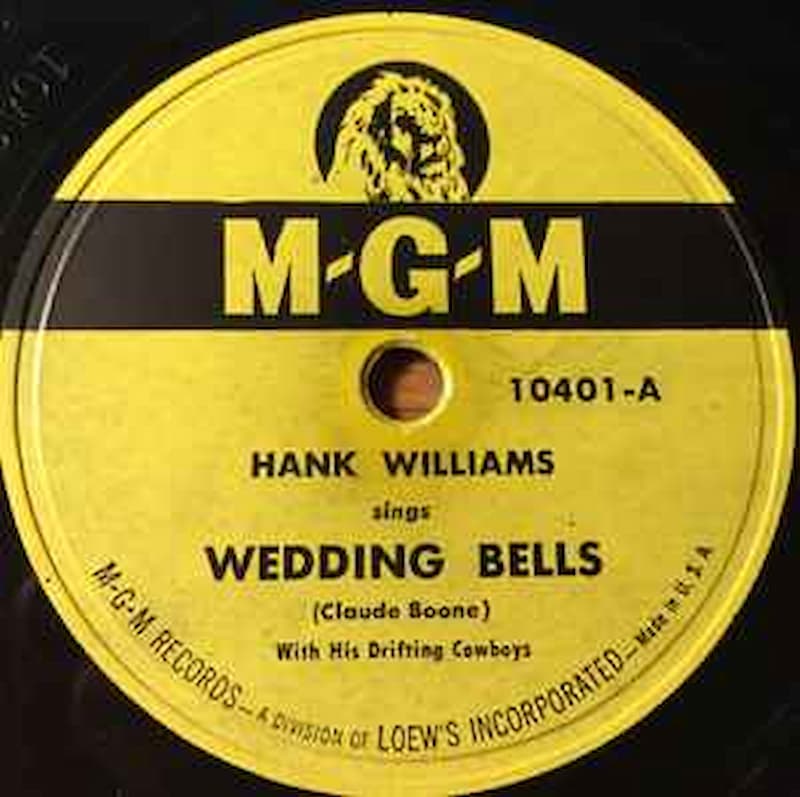
“Wedding Bells” is a country song written by Claude Boone and recorded by Hank Williams with His Drifting Cowboys for MGM Records. Williams cut the track at Castle Studio in Nashville, Tennessee, on March 20, 1949, with Fred Rose producing. Issued as single MGM 10401 and released on May 1, 1949, it featured “I’ve Just Told Mama Goodbye” on the B-side. The record followed directly after Williams’s breakthrough hit “Lovesick Blues” and is usually classified as hillbilly, honky-tonk and country blues in style. On Billboard’s Best Selling Retail Folk (country) chart, “Wedding Bells” peaked at No. 2 in 1949, confirming his growing status as a major country star.
The song did not originate with Williams. “Wedding Bells” was first recorded in 1947 by Bill Carlisle for King Records. Historian Colin Escott reports that guitarist and songwriter Claude Boone obtained the song from James Arthur Pritchett, a Knoxville musician better known under the stage name Arthur Q. Smith, reportedly paying him a small sum for the rights. Boone then secured publishing through Hometown Music and is the credited composer on subsequent releases. Williams heard the song through the Knoxville music circle and became a strong champion of it, later calling it “the prettiest song he’d ever heard.”
The March 20, 1949 session that produced “Wedding Bells” used many of Williams’s regular studio collaborators. He was supported by Dale Potter on fiddle, Don Davis on steel guitar, Zeb Turner on electric guitar, Jack Shook on rhythm guitar and Velma Williams (no relation) on bass. Biographical notes highlight that this session took place just after Williams’s first airplane flight; he reportedly wired Fred Rose beforehand with the line, “Flight 58 will arrive at 5:45. I hope.” The recording runs just under three minutes and presents a measured, mid-tempo performance that leaves space for the vocal and steel guitar to carry most of the emotional effect.
Lyrically, “Wedding Bells” is sung from the perspective of a man watching the woman he loves marry somebody else. He describes receiving the wedding invitation, imagining the ceremony in the chapel and picturing the roses, orange blossoms and children’s laughter, while knowing that “those wedding bells will never ring for me.” The language is simple and direct, using standard romantic imagery and a straightforward verse–chorus structure. The emotional focus is on quiet resignation rather than anger, which distinguishes it from some of Williams’s sharper honky-tonk songs about jealousy and infidelity.
On release, “Wedding Bells” became a significant follow-up to “Lovesick Blues.” Chart references place it at No. 2 on the country best-seller lists, just short of the top position but strong enough to maintain Williams’s momentum on radio and jukeboxes. Paired with the equally sentimental “I’ve Just Told Mama Goodbye,” it gave MGM a commercially effective single that balanced heartbreak themes in two different settings—romantic loss on the A-side and family loss on the flip. The record helped establish a pattern in which Williams alternated between his own compositions and carefully chosen outside material that matched his vocal style and public image.
Over time, “Wedding Bells” has become a standard in the country repertoire. It has been recorded by a wide range of artists, including Buddy Williams (1951), Hank Snow (1957), Marty Robbins (1958), George Jones (1962), Dean Martin (1965), Charlie Rich (1967), Glen Campbell (1973), Bill Anderson (1968), Margo Smith (whose 1982 version reached the lower end of the Billboard country chart) and many others. These covers, along with frequent inclusion on Hank Williams compilations such as 40 Greatest Hits, have kept the song in circulation and reinforced its reputation as one of the classic country ballads of the postwar era.
Within Hank Williams’s catalogue, “Wedding Bells” is often singled out as a key example of his ability to interpret material written by others and make it feel personal. Although the lyric came from Claude Boone (and ultimately from Arthur Q. Smith), Williams’s phrasing, timing and subtle breaks in tone give the recording a sense of lived-in heartbreak that listeners tend to associate directly with him. As a result, the 1949 MGM single remains the reference version of the song and a staple in discussions of Williams’s early chart success and his influence on later country ballad singing.
Video
Lyric
I have the invitation that you sent me
You wanted me to see you change your name
I couldn’t stand to see you wed another
But dear, I hope you’re happy just the same
Wedding bells are ringing in the chapel
That should be ringing out for you and me
Down the aisle with someone else you’re walking
Those wedding bells will never ring for me
I planned a little cottage in the valley
I even bought a little band of gold
I thought some day I’d place it on your finger
But now the future looks so dark and cold
Wedding bells are ringing in the chapel
I hear the children laughing out with glee
At home alone I hang my head in sorrow
All wedding bells will never ring for me
I fancy that I see a bunch of roses
A blossom from an orange tree in your hair
While the organ plays, I love you truly
Please let me pretend that I am there
Wedding bells are ringing in the chapel
Ever since the day you set me free
I knew someday that you would wed another
But wedding bells will never ring for me