About The Song
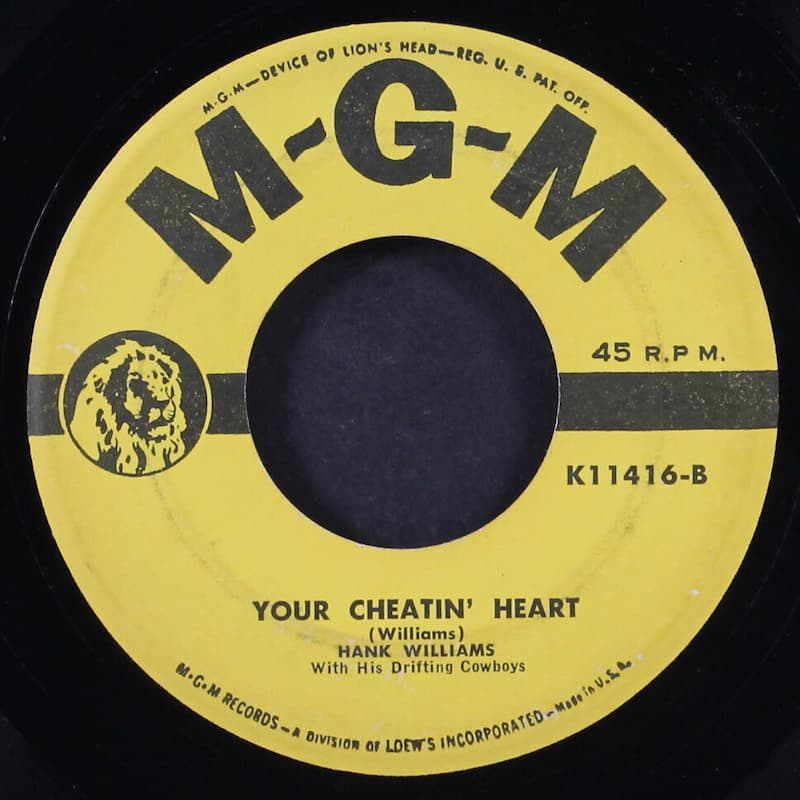
“Your Cheatin’ Heart” is a country and western song written and recorded by American singer-songwriter Hank Williams. He cut the track at Castle Studio in Nashville, Tennessee, on September 23, 1952, during what would be his final recording session for MGM Records. Produced by Fred Rose, the session also yielded “Kaw-Liga,” “I Could Never Be Ashamed of You,” and “Take These Chains from My Heart.” The single was released posthumously in late January 1953 as MGM K 11416, with “Kaw-Liga” on the A-side and “Your Cheatin’ Heart” on the B-side, and was published by Acuff-Rose in October 1952.
The song’s genesis is closely linked to Williams’s personal life. According to accounts from his second wife, Billie Jean Jones, the phrase “your cheatin’ heart” came up while the couple were driving from Nashville to Shreveport and talking about Williams’s first wife, Audrey Sheppard. Williams reportedly told Jones to get out his notebook and dictated the lyrics in a matter of minutes. Biographers such as Colin Escott emphasize that the song drew on Williams’s ongoing sense of betrayal and emotional turmoil following the breakdown of his first marriage, making it one of his most autobiographical-sounding compositions.
Musically, “Your Cheatin’ Heart” is a mid-tempo honky-tonk ballad in 3/4 time, built around a simple chord progression and a memorable, descending melodic line in the chorus. The recording features Williams on vocals and rhythm guitar, backed by Tommy Jackson on fiddle, Don Helms on steel guitar, Chet Atkins on lead guitar, Jack Shook on rhythm guitar and Floyd “Lightnin’” Chance on bass. Fred Rose made small changes to the lyric before the session but otherwise kept the arrangement straightforward, allowing Williams’s vocal phrasing and timbre to carry most of the emotional weight.
Released only weeks after Williams’s death on January 1, 1953, the single quickly became a commercial success. “Your Cheatin’ Heart” reached No. 1 on Billboard’s Top Country & Western Records chart and remained there for six weeks, while combined sales of the double-sided hit surpassed one million copies. The strong chart performance, coming in the wake of widespread publicity about Williams’s death, helped cement the song’s association with his public image as a troubled, authentic voice of heartbreak.
Lyrically, the song is built around a direct address to an unfaithful partner. The narrator predicts that guilt and regret will eventually catch up with the “cheatin’ heart,” bringing sleepless nights and tears. The text uses simple, repetitive phrases—”your cheatin’ heart will make you weep”—rather than detailed narrative, leaving space for interpretation and for the singer’s delivery to supply nuance. Commentators have pointed out that this combination of plain language and intense feeling is characteristic of Williams’s best work and makes the song easy to adapt across styles.
“Your Cheatin’ Heart” has since become one of the most frequently covered songs in country music. Joni James’s 1953 pop version reached No. 2 on Billboard’s Most Played in Jukeboxes chart, and Frankie Laine’s recording also made the U.S. pop charts the same year. Ray Charles’s 1962 interpretation, included on his album of country material, entered the Billboard Hot 100 and Top R&B Singles charts and reached No. 13 on the UK Singles Chart, demonstrating the song’s crossover potential. Many other artists, including Elvis Presley and Patsy Cline, have recorded their own versions for albums and film soundtracks.
In critical terms, “Your Cheatin’ Heart” is often regarded as Hank Williams’s signature song and, in the words of historian Colin Escott, a piece that virtually “defines country music.” It lent its title to the 1964 biographical film about Williams, and his original 1953 recording was inducted into the Grammy Hall of Fame in 1983. The track appears on numerous lists of the greatest country and popular songs, including Rolling Stone’s 500 Greatest Songs of All Time and Country Music Television’s 100 Greatest Songs in Country Music. Today it remains one of the most recognizable examples of Williams’s work and a standard in both country repertoire and American popular music more broadly.
Video
Lyric
Your cheatin’ heart will make you weep
You’ll cry and cry and try to sleep
But sleep won’t come the whole night through
Your cheatin’ heart will tell on you
When tears come down like fallin’ rain
You’ll toss around and call my name
You’ll walk the floor the way I do
Your cheatin’ heart will tell on you
Your cheatin’ heart will pine someday
And crave the love you threw away
The time will come when you’ll be blue
Your cheatin’ heart will tell on you
When tears come down like fallin’ rain
You’ll toss around and call my name
You’ll walk the floor the way I do
Your cheatin’ heart will tell on you